
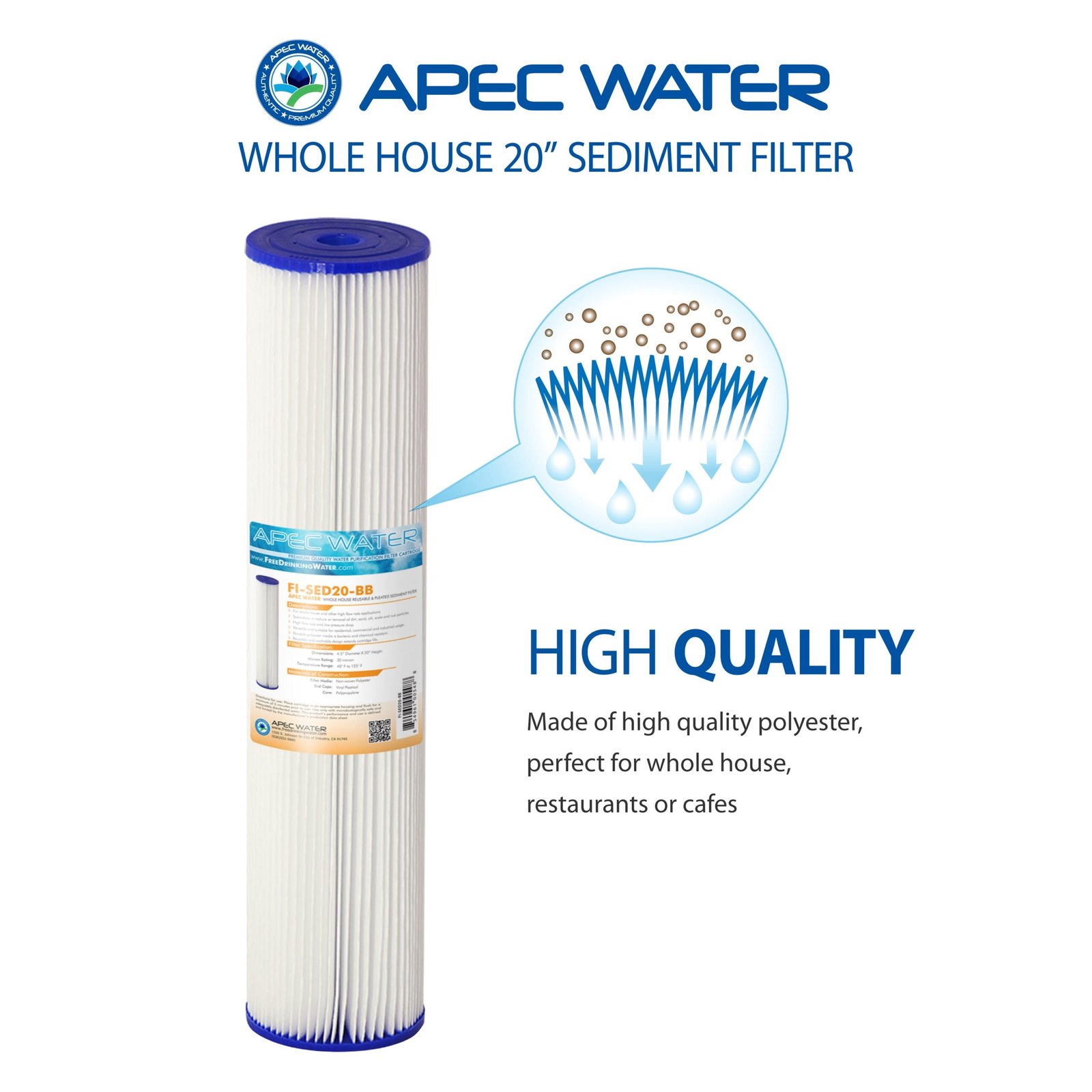
A whole house sediment filter removes suspended particles from water before they reach household plumbing, fixtures, water heaters, appliances, and other treatment equipment. It is commonly installed near the point where well water enters the home, so filtered water is supplied throughout the house.
For private well owners, sediment can include sand, silt, fine clay, rust particles, organic debris, or material disturbed by changes in groundwater conditions. The right filter depends on the type and amount of sediment, the home’s peak water demand, and whether other equipment such as a water softener, iron filter, UV system, or reverse osmosis unit is also present.
A sediment filter can protect equipment and improve water clarity, but it does not automatically make well water safe to drink. It does not reliably remove dissolved contaminants, bacteria, nitrate, arsenic, or other hazards unless the system is specifically designed and certified for those contaminants.
What a Whole-House Sediment Filter Does
Sediment filtration works by physically capturing particles as water passes through a filter screen, cartridge, media bed, or other barrier. The filter’s micron rating indicates the approximate size of particles it is intended to capture. A micron is one-millionth of a meter, so smaller micron ratings target finer particles.
In a whole-house system, sediment filtration is usually the first treatment stage. Removing debris early can reduce clogging, pressure loss, wear, and maintenance needs in downstream equipment.
A sediment filter may help with:
- Visible sand or grit in toilet tanks, faucet aerators, and appliance screens
- Cloudy water caused by suspended particles
- Silt or dirt that appears after heavy rain, flooding, well repairs, or groundwater disturbance
- Rust-colored particles from corroding plumbing or well components
- Premature fouling of water softeners, carbon filters, UV systems, and reverse osmosis prefilters
- Wear on valves, washing machines, dishwashers, water heaters, and pressure-system components
Its limits are equally important. A cartridge that makes water look clear may not remove dissolved iron, manganese, hydrogen sulfide, hardness minerals, pesticides, fuel-related chemicals, or microorganisms. Clear water is not proof of safe water.
Signs Your Well Water May Need Sediment Filtration
Some sediment problems are obvious, but others show up as equipment trouble rather than visibly dirty water. Before selecting a filter, note when the issue occurs and whether it affects every fixture.
- Sand or grit collects in bathtub bottoms, toilet tanks, or sink aerators.
- Water looks cloudy immediately after it is drawn and particles settle over time.
- Faucet aerators, showerheads, appliance inlet screens, or filter cartridges clog frequently.
- Water pressure gradually falls as filters or plumbing screens collect debris.
- A water softener, iron filter, or UV prefilter needs unusually frequent cleaning or service.
- Cloudiness or particles began after a well repair, pump work, flooding, construction, or a change in water level.
- Only hot water contains particles, which can point to a water-heater issue rather than incoming well water.
Check whether the problem is at one fixture or throughout the home. Debris limited to a single faucet may come from a clogged aerator or local plumbing section. Particles at both hot and cold fixtures throughout the house are more likely to originate upstream of the home’s distribution plumbing.
If water quality changes suddenly, especially after flooding or well damage, treat the change as a reason to investigate rather than simply installing a finer cartridge. A certified laboratory test and an inspection by a qualified well professional may be appropriate. Sediment itself may be an aesthetic or mechanical issue, but a change in water quality can also signal a source-water or well-integrity concern.
Types of Whole-House Sediment Filters
There is no single best whole house sediment filter for every well. The most suitable design depends on particle size, sediment load, desired maintenance level, available flow rate, and the rest of the treatment system.
Spin-down and reusable screen filters
Spin-down filters use a reusable mesh screen, often housed in a clear or opaque chamber. Water movement helps direct larger particles toward the bottom of the housing, where they can be flushed or cleaned according to the manufacturer’s instructions.
They are often useful as a first stage when a well produces visible sand, grit, or coarse debris. A spin-down unit can reduce the burden on finer disposable cartridges, but it generally does not replace fine filtration when the water contains silt or very small particles.
Key considerations include screen size, flow rating, flushing method, and whether the collected material can be removed easily. A screen that is too fine for a high-sediment well may clog quickly and create noticeable pressure loss.
Pleated sediment cartridges
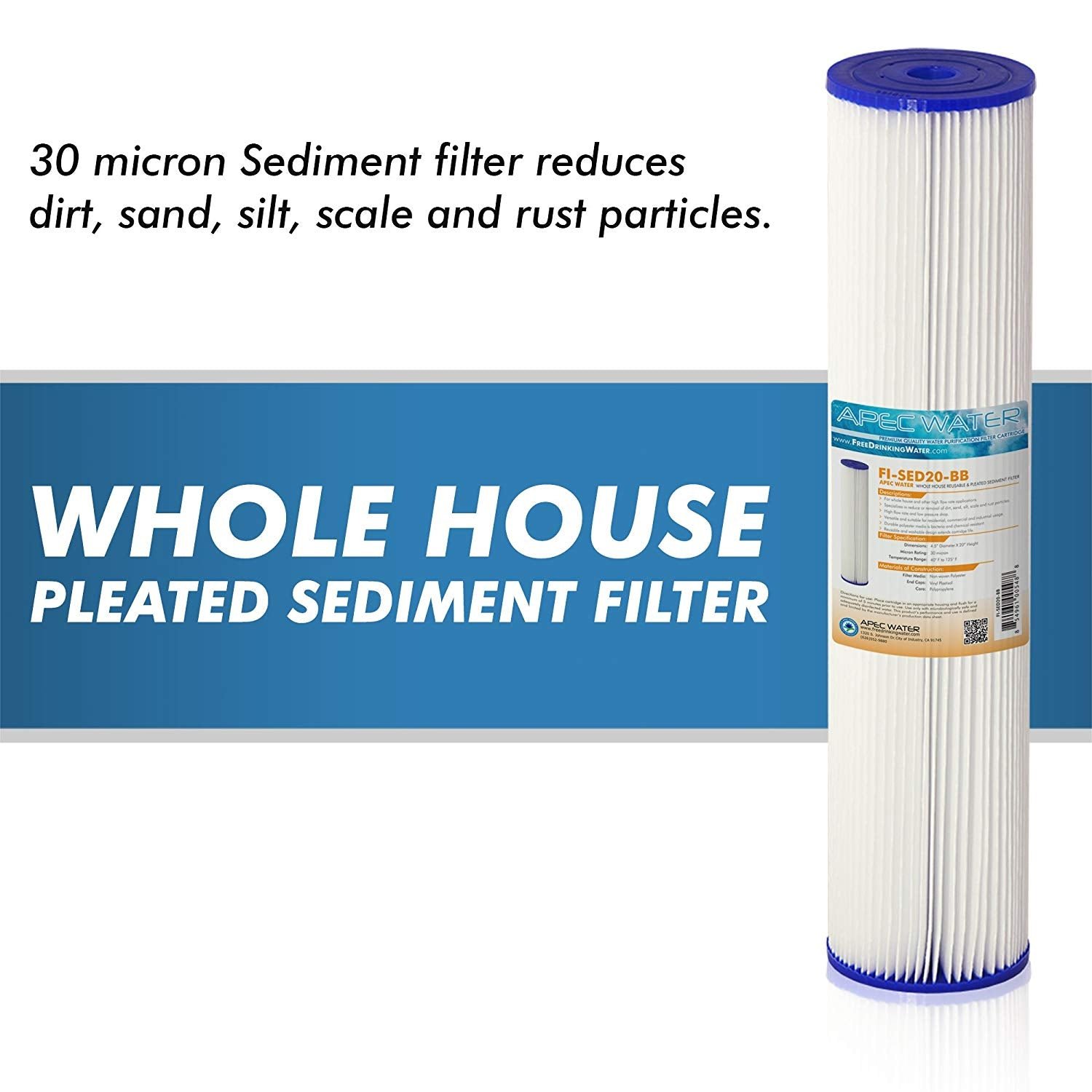
Pleated cartridges have folded filter material that provides more surface area than a simple depth cartridge of the same size. Many are washable or reusable for limited periods, depending on the cartridge material and the type of sediment captured.
They are often a practical choice for moderate loads of sand, rust particles, or larger suspended debris. Their larger surface area can help them last longer than smoother cartridge designs when the particles are relatively coarse.
Cleaning is not always the best answer. If a cartridge remains discolored, damaged, compressed, or difficult to rinse thoroughly, replacement may be more reliable than repeated reuse.
Depth sediment cartridges
Depth filters capture particles throughout the thickness of the filter media rather than mainly on the outer surface. Common styles include spun, string-wound, or melt-blown cartridges.
These cartridges can be effective for fine silt, clay, and rust particles. They are usually disposable and may clog faster than pleated filters when the water contains a heavy load of large debris. For that reason, many systems use a coarse prefilter before a finer depth cartridge.
Multi-stage cartridge systems
A multi-stage setup uses filters with progressively finer ratings. For example, a coarse first stage can capture larger grit while a finer second stage handles smaller suspended material. This approach can extend the life of the final cartridge and reduce abrupt pressure loss.
Multi-stage filtration is most helpful when water contains a mix of particle sizes. It should be designed around actual water conditions, not simply built by adding the finest cartridges available.
Backwashing sediment filters
Backwashing filters use a media tank and control valve to periodically rinse collected material to a drain. They can be useful for homes with sustained sediment loads where replacing cartridges would be inconvenient or expensive.
These systems need adequate flow, a suitable drain connection, and correct setup for the water conditions. They are not automatically better than cartridge filters. Fine clay, unusual particle characteristics, low well yield, or limited drainage can affect whether a backwashing design is appropriate.
Micron Ratings: Why Smaller Is Not Always Better
A micron rating is important, but it should not be the only selection criterion. Choosing an extremely fine filter may improve particle capture while also reducing flow and shortening cartridge life.
| Filter range | Common role | Potential trade-off |
|---|---|---|
| Coarse filtration | Capturing sand, grit, and larger debris before finer treatment | May allow fine silt or haze-causing particles through |
| Medium filtration | General protection for fixtures and downstream treatment equipment | Can clog faster if the well produces significant sediment |
| Fine filtration | Reducing fine suspended particles and protecting sensitive equipment | Greater pressure drop and more frequent maintenance are possible |
Manufacturers may describe filters as nominal or absolute rated. A nominal rating generally means the filter is intended to reduce a stated percentage of particles around a given size under defined conditions. An absolute rating is typically more stringent, but exact performance still depends on the manufacturer’s testing method and specifications.
Do not assume that a micron rating alone means a filter provides microbial protection. Particle filters are not a substitute for properly designed disinfection. If a household needs protection from bacteria or other microorganisms, treatment should be based on laboratory results and may require a correctly sized UV system, disinfection process, source repair, or another targeted solution.

Credit: ifilters.com
How to Size a Sediment Filter for Your Home
Proper sizing is about more than the diameter of the filter housing. A whole-house sediment filter must provide enough flow during peak household use without causing unacceptable pressure loss as the filter collects debris.
Start with household flow demand
Water flow is measured in gallons per minute, or GPM. A home may need water at more than one fixture at the same time, such as a shower, washing machine, dishwasher, or outdoor hose connection. The filter should be selected for the home’s expected peak demand, not just average daily water use.
Compare the manufacturer’s flow information with your pressure system and the capacity of other treatment equipment. A restrictive filter can become the bottleneck even when the well pump and pressure tank are functioning properly.
Consider housing size and connection size
Larger filter housings typically hold larger cartridges with more media surface area. This can help support higher flow and longer service intervals. Smaller housings may be adequate for a low-demand household with light sediment, but they can become inconvenient when sediment loads are high.
Plumbing connection size matters as well. A filter with undersized ports or restrictive internal passages can create pressure loss, especially when several fixtures run at once. The installed system should be compatible with the home’s plumbing layout and pressure-system capacity.
Match the filter to sediment quantity and particle size
A homeowner dealing with occasional coarse grit has different needs from one with persistent fine clay. A coarse reusable prefilter may work well for the first situation. The second may require staged cartridge filtration, a larger housing, or evaluation of the well and source conditions.
If sand is substantial or recurring, do not rely only on increasingly fine cartridges. Sand can damage pumps and valves, and its presence may warrant a professional evaluation of the well screen, casing, pump placement, or other well components.
Plan around downstream equipment
When a home has more than one treatment device, sediment filtration is often placed upstream of equipment that can foul easily. Examples include:
- Water softeners, which can be affected by debris in control valves and resin beds
- Activated carbon filters, which may clog prematurely when handling sediment
- UV disinfection systems, which need clear enough water for ultraviolet light to work effectively
- Reverse osmosis systems, which usually require appropriate prefiltration to protect their membranes
System order is not universal. Iron, manganese, sulfur odor, acidity, hardness, and microbial concerns may require a different treatment sequence. Use a water test and the equipment manufacturers’ requirements to plan the full system.
Where a Whole-House Sediment Filter Is Installed
A whole-house sediment filter is typically installed on the main water line after the well pressure system and before water branches to most household fixtures and treatment devices. The exact location depends on the plumbing design, freeze protection, access for maintenance, and the type of pressure system in use.
The filter should be in a location where cartridges can be changed without damaging finished surfaces or creating a difficult cleanup problem. It should also be protected from freezing, direct weather exposure, and physical impact.
A well-designed installation commonly includes shutoff valves that allow the filter housing to be isolated for service. A bypass may be appropriate in some systems, but it should not be used to send untreated water through equipment that depends on sediment prefiltration. Installation details must also follow local plumbing requirements and the manufacturer’s instructions.
Working on plumbing may be manageable for an experienced homeowner, but avoid electrical work around the well pump, pressure switch, controller, or other live components. If the installation requires changing main water lines, adding drain connections, or modifying a pressure system, a qualified plumber or well professional can help prevent leaks, flow restrictions, and equipment compatibility problems.

Credit: apecwater.com
Maintenance: Replace Filters Before They Become a Pressure Problem
Sediment filter maintenance is based on water conditions, not a universal calendar. A cartridge may need replacement when it is visibly loaded, when water pressure drops noticeably, or when the manufacturer’s recommended service interval is reached.
Common signs that service is due include:
- Reduced pressure at multiple fixtures, especially when water demand is high
- A large pressure difference between gauges installed before and after the filter
- A cartridge that is heavily coated with sediment or appears collapsed
- Cloudiness or particles returning after the filter
- Frequent clogging of faucet aerators despite a filter being installed
Turn off or isolate the water supply and relieve water-side pressure according to the housing manufacturer’s instructions before opening a filter housing. Do not force a stuck housing, reuse a damaged O-ring, or operate a cracked filter vessel. Clean and lubricate seals only with products approved for the housing and potable-water use.
Keep a simple maintenance record that notes the installation date, cartridge type, observed water conditions, pressure symptoms, and replacement date. This record can reveal whether sediment levels are increasing and gives a contractor useful information if a well problem develops.
Common Problems and What They May Mean
Pressure drops soon after installing a new filter
The filter may be too fine, too small for household demand, incorrectly installed, or already loaded with sediment. Check that any service valves are fully open and that the filter is installed in the correct flow direction. If low pressure affects the entire house even with the filter bypassed, the cause may be elsewhere in the pressure system, plumbing, pump, or well.
Cartridges clog much faster than expected
Fast clogging can mean the sediment load is heavier than the chosen filter can handle. A coarser first stage, larger housing, or reusable prefilter may reduce cartridge use. It can also indicate a recent change in the well or groundwater conditions. If the problem is new or worsening, investigate the cause rather than treating cartridge replacement as the only solution.
Water remains cloudy after sediment filtration
The particles may be smaller than the filter rating, or the cloudiness may not be sediment. Dissolved minerals, air bubbles, microorganisms, and chemical conditions can also change the appearance of water. If a glass of water clears from the bottom upward after standing, that may suggest air bubbles; if particles settle, suspended matter is more likely. Neither observation identifies all possible contaminants.
Only hot water has particles or discoloration
If cold water is clear but hot water contains debris, inspect the water-heating side of the system. Sediment may be coming from the water heater or hot-water plumbing rather than the incoming well water. A whole-house filter may not correct that source.
Choosing a System Based on Water Testing and Observation
Visual inspection helps identify a sediment problem, but it does not replace water testing when health-related contaminants are a concern. Private wells are not regulated like public water systems, so homeowners are responsible for monitoring their water quality.
A laboratory can help assess concerns that a sediment filter cannot answer, including coliform bacteria, E. coli, nitrate, arsenic, lead, pH, hardness, iron, manganese, and other locally relevant contaminants. The appropriate panel depends on the area, well history, nearby land use, and the symptom being investigated.
Follow the laboratory’s sample collection instructions exactly. Sample containers, preservation, timing, and delivery requirements vary by analyte. A negative result applies only to the sample tested, the contaminants included, and the laboratory’s detection limits.
For general private-well safety information, the U.S. Environmental Protection Agency provides guidance at EPA: Protect Your Home’s Water. Contact a local health department, cooperative extension office, or qualified water professional for local testing recommendations and well-specific concerns.
Credit: apecwater.com
FAQ
How often should a whole-house sediment filter be changed?
Change intervals depend on sediment load, cartridge design, household water use, and acceptable pressure loss. Replace or clean the filter when it becomes loaded, pressure declines, or the manufacturer’s service guidance calls for maintenance. A new system may need more frequent checks until you understand your well’s sediment pattern.
Can a sediment filter remove iron stains from well water?
It can capture particulate iron that has already oxidized into visible rust-colored particles. However, much well-water iron is dissolved when it enters the home and passes through ordinary sediment filters. Dissolved iron usually needs treatment designed for the measured iron level and water chemistry.
Will sediment filtration remove a rotten-egg odor?
Usually not. Rotten-egg odor is often associated with hydrogen sulfide gas, sulfur-related bacteria, or water-heater conditions. Sediment filtration may remove particles but does not reliably remove dissolved gases or resolve the underlying cause. Testing and diagnosis are needed before selecting odor treatment.
Is a clear filter housing better than an opaque one?
A clear housing makes it easier to see sediment buildup, but it may allow light exposure that can encourage growth in some conditions. An opaque housing prevents visual inspection but may be preferable where light exposure is a concern. Choose a housing rated for the installation location and inspect or service it on an appropriate schedule.
Can I use a whole-house sediment filter with a UV water treatment system?
Yes, sediment prefiltration is often important before UV treatment because suspended particles can reduce UV effectiveness or shield microorganisms. The required water clarity and prefilter specifications should come from the exact UV manufacturer’s manual, and UV should be selected only after considering appropriate water testing and the full treatment need.