
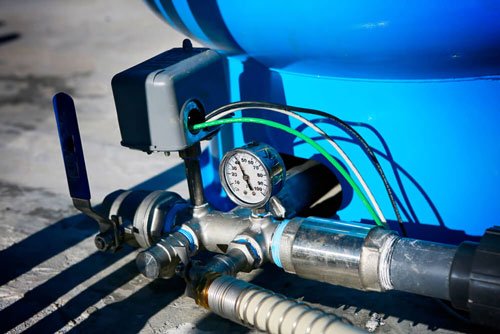
A well pressure tank stores water under pressure so your well pump does not need to start every time someone opens a faucet. It works with the pump and pressure control system to deliver steady water to the home, reduce pump wear, and provide a small reserve of pressurized water between pump cycles.
If you are asking, “how does a well pressure tank work,” the short answer is that compressed air inside the tank pushes stored water through your plumbing. As water leaves the tank, pressure falls. Once pressure reaches the system’s lower setting, the pump starts and refills the tank. The pump stops again when the upper pressure setting is reached.
Although the tank is an important part of the system, it does not create water pressure by itself. The pump supplies water, the pressure tank stores usable pressurized water, and the pressure switch or electronic controller tells the pump when to run.
The Main Job of a Well Pressure Tank
A private well system needs a way to meet small, frequent water demands without making the pump turn on and off constantly. A pressure tank fills that role.
Without a working pressure tank, opening a faucet for a few seconds could cause the pump to start immediately. Frequent starts are hard on pump motors, switches, relays, and other electrical components. A properly operating tank allows the household to use a limited amount of water before the pump needs to run.
A pressure tank has three main purposes:
- Stores a usable amount of pressurized water: This is called drawdown.
- Limits pump cycling: The tank reduces how often the pump starts and stops during normal use.
- Smooths household water delivery: It helps maintain pressure while water is being used at faucets, showers, toilets, and appliances.
The tank is part of a larger system. Its performance depends on the well pump, water level in the well, plumbing restrictions, pressure controls, check valves, leaks, and household water demand.
How Does a Pressure Tank for a Water Well Work Step by Step?
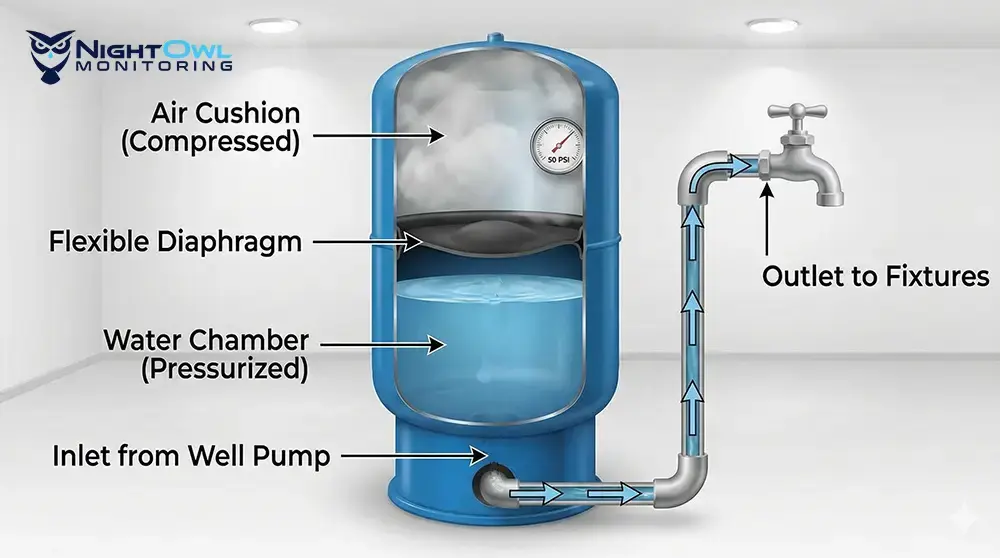
Most modern residential pressure tanks use a bladder or diaphragm to separate water from compressed air. The air side acts like a spring: as water enters, the air compresses; as water leaves, the compressed air expands and pushes water into the plumbing.
- The tank begins at its upper pressure setting. The pump has filled the tank, compressed the air cushion, and shut off.
- A fixture opens. When someone uses water, compressed air pushes stored water out of the tank and into the home’s plumbing.
- System pressure drops. Water use reduces both the water volume in the tank and the pressure shown on the pressure gauge.
- The pump starts at the lower setting. When pressure reaches the cut-in setting, the pressure switch or controller starts the pump.
- The pump supplies water to the home and tank. While water is being used, the pump may supply some water directly to fixtures while also replenishing the tank.
- The pump stops at the upper setting. Once the system reaches the cut-out pressure, the control shuts the pump off and the cycle begins again.
This repeated process is normal. The goal is not to prevent cycling entirely, but to keep cycles reasonably spaced and avoid rapid on-and-off operation.
Key Parts of a Typical Well Pressure System
Understanding the individual components makes it easier to see why a pressure problem is not always a tank problem.
| Component | What It Does | Why It Matters |
|---|---|---|
| Well pump | Moves water from the well into the home’s plumbing. | The pump must produce enough flow and pressure for the system’s demand and plumbing conditions. |
| Pressure tank | Stores water under pressure using an air cushion. | Provides drawdown and reduces pump starts. |
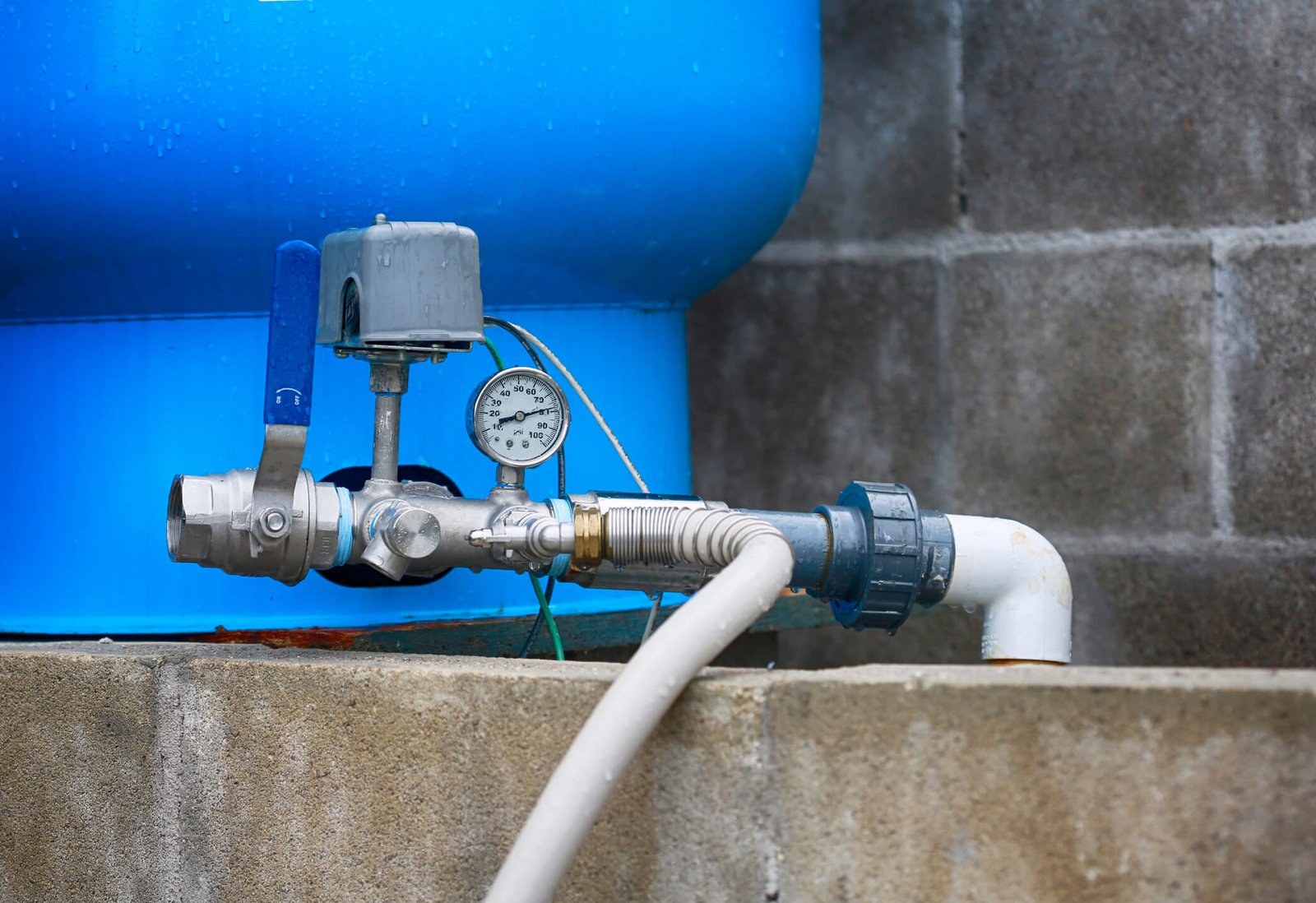
| Pressure switch or controller | Starts and stops the pump based on pressure or programmed controls. | Determines when the pump cycles in a conventional system. |
| Pressure gauge | Shows system pressure. | Helps identify whether pressure is falling, rising, or fluctuating abnormally. |
| Check valve | Helps prevent water from flowing backward toward the well. | A failed or improperly placed valve can contribute to pressure loss and cycling problems. |
| Pressure relief valve | Provides a safety path if pressure rises excessively. | It is an important safety component and should not be blocked or bypassed. |
Air Pressure, Water Pressure, and Drawdown
A common source of confusion is the difference between the tank’s air charge, the plumbing system’s water pressure, and the tank’s drawdown.
Air precharge
Air precharge is the air pressure inside an empty bladder or diaphragm tank before water pressure is applied. It is measured at the tank’s air valve, similar to a tire valve, but a pressure tank is not a tire and should not be adjusted casually.
The correct precharge depends on the tank design and the control method used. In many conventional pressure-switch systems, the manufacturer specifies a relationship between precharge and the pump’s start pressure. However, that relationship does not automatically apply to every setup, especially systems with variable-speed pumps, constant-pressure controllers, specialty tanks, or nonstandard controls.
If a precharge check is appropriate, turn off power to the pump and fully relieve water-side pressure first, following the tank manufacturer’s instructions. Never check or adjust air charge while the tank is still pressurized with water, and do not work on live pump controls.
Water pressure
Water pressure is the pressure in the plumbing system. A gauge near the tank often shows it in pounds per square inch, or psi. This pressure changes as water is used and as the pump refills the system.
Water pressure affects shower performance and fixture flow, but pressure is not the same as flow rate. A system may show normal pressure at rest yet provide weak flow if there is a clogged filter, restricted pipe, partially closed valve, failing pump, or limited well yield.
Drawdown
Drawdown is the amount of water a pressure tank can deliver between pump shutoff and pump startup. It is not the same as the tank’s total physical volume.
For example, a large tank does not hold its full labeled volume as usable water because a substantial portion of the interior must remain air space. Drawdown also changes with the pressure settings and the tank’s air charge. This is why tank sizing should be based on the manufacturer’s drawdown information at the actual operating pressure range, not just the number of gallons printed on the tank label.
Types of Well Pressure Tanks
Credit: nightowlmonitoring.com
Bladder pressure tanks
Bladder tanks are common in modern private well systems. A flexible bladder holds the water, while compressed air occupies the space around it. The separation helps prevent air from dissolving into the water, reducing the need to add air periodically.
When the bladder is intact and the tank is properly charged, water and air remain separated. These tanks are generally compact and low maintenance, but the bladder can eventually fail.
Diaphragm pressure tanks
Diaphragm tanks also separate air and water, but they use a flexible diaphragm rather than a full internal bladder. Their operating principle is similar: incoming water compresses a sealed air cushion, and that air cushion pushes water back into the plumbing when a fixture opens.
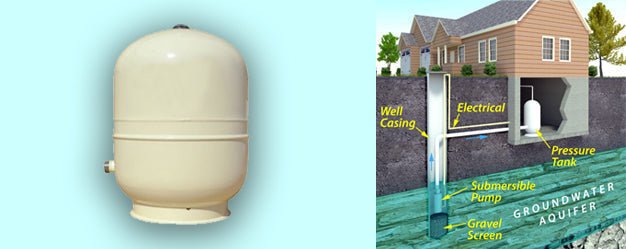
Replacement decisions should be based on the exact tank design, condition, available drawdown, pressure rating, plumbing connection, and compatibility with the rest of the water system.
Older air-over-water tanks
Older systems may use a plain steel tank with water and air in direct contact. These tanks can work well, but air can gradually dissolve into the water and be carried away through household use. When that happens, the tank may lose its air cushion and become waterlogged.
Some older systems use air-volume controls or other equipment to maintain the proper air level. They should not be treated exactly like modern captive-air tanks. If you have an older tank, identify its design before attempting any maintenance.
Constant-pressure systems
Some homes use variable-speed pumps or constant-pressure controllers. These systems may use a smaller pressure tank because the controller adjusts pump output to maintain pressure more continuously.
A small tank in this type of system is not automatically undersized. It may serve a different purpose than a conventional large drawdown tank. Follow the pump and controller manufacturer’s requirements rather than applying conventional pressure-switch assumptions.
Why Tank Size Matters
A pressure tank that is too small for a conventional system may lead to frequent cycling, especially during low-flow uses such as a slow-running faucet, ice maker, or water treatment regeneration cycle. A larger tank can provide more drawdown and allow longer pump run times, but bigger is not always necessary or practical.
Proper sizing depends on more than household size. Important factors include:
- Pump flow rate at the home’s actual operating conditions
- Pressure switch or controller settings
- Expected household demand
- Well yield and pumping water level
- Whether the home uses irrigation, livestock watering, large tubs, or frequent appliance loads
- Water treatment equipment that requires a certain service flow or regeneration flow
- Available installation space and the tank’s pressure rating
Well depth alone does not determine tank size. More important pump factors include the pumping water level, the vertical lift to the home, pressure needed at the tank, pipe friction, and the pump curve. A contractor evaluating an upgrade should consider the full system rather than selecting a tank based only on horsepower or total well depth.
What Normal Pump Cycling Looks Like
In a conventional pressure-switch system, it is normal for the pump to start after enough water has been used to deplete the tank’s drawdown. The pump should then run long enough to restore pressure and shut off at the upper setting.
Cycle length varies by tank size, pressure range, water use, pump capacity, and well conditions. A shower may cause the pump to run for much of the time the shower is in use. That alone does not mean there is a problem.
Short cycling is different. It usually describes rapid, repeated starts and stops, often every few seconds or minutes, while water demand continues. This can strain the pump and controls and deserves prompt attention.
Credit: freshwatersystems.com
Signs a Pressure Tank or Pressure System May Need Attention
A pressure tank is only one possible cause of water system symptoms. Start by observing what happens at the pressure gauge and whether the issue affects the entire home or only one fixture.
Rapid pump cycling
If the gauge repeatedly drops to the start point and quickly rises to the shutoff point while water is still running, the tank may have lost usable drawdown. Possible causes include a failed bladder or diaphragm, incorrect air charge, a waterlogged older tank, a malfunctioning control, or a system configuration issue.
A restricted filter, a closed valve, or low well yield can create different pressure and flow symptoms, so rapid cycling should not be treated as proof that the tank has failed.
Water from the air valve
If water comes out of the tank’s air valve, the internal bladder or diaphragm is likely compromised. This is a strong sign that the tank needs professional evaluation or replacement. Do not continue adding air as a long-term workaround.
Pressure drops when no water is being used
A pressure gauge that falls while no fixture is running may indicate a plumbing leak, leaking toilet, irrigation issue, faulty check valve, or pump-side problem. The tank may be holding pressure normally while another part of the system is allowing water to escape or flow backward.
Weak flow at one faucet only
When low flow affects one fixture but the rest of the home is normal, the pressure tank is unlikely to be the main cause. Check for a clogged aerator, partially closed local stop valve, blocked showerhead, or fixture-specific problem.
Low pressure throughout the home
Whole-house low pressure can involve a clogged sediment filter, treatment equipment restriction, pressure switch or controller issue, pump problem, plumbing blockage, low well water level, or a pressure tank problem. Comparing gauge readings before and after filters or treatment equipment can help narrow the cause.
Safe Checks Homeowners Can Make
Well systems combine water, pressure vessels, and electricity. Do not remove pressure-switch covers, work on live wiring, bypass a safety device, repeatedly reset a tripped breaker, or pressurize a visibly damaged tank. Call a qualified well or pump professional if electrical components, a leaking pressure vessel, or a pump pull is involved.
Safe observations that can help diagnose a problem include:
- Watch the pressure gauge while a faucet runs and note whether the pump cycles unusually fast.
- Check whether the issue affects every fixture or only one area of the home.
- Look for obvious leaks around the tank, fittings, filters, toilets, outdoor hydrants, and irrigation equipment.
- Confirm that bypass valves and shutoff valves are fully open where appropriate.
- Check whether a sediment filter cartridge or treatment system is overdue for service according to its instructions.
- Note recent changes, such as a power outage, plumbing repair, flooding, new treatment equipment, or a sudden change in water use.
These details give a service professional a better starting point. Useful information includes the pressure gauge behavior, tank model, pump type if known, control type, filter service history, and whether the pump is cycling when no water is being used.
Maintenance That Helps Protect the System
Most captive-air pressure tanks need little routine maintenance, but the surrounding water system still benefits from periodic observation.
- Inspect the tank exterior and plumbing connections for corrosion, moisture, or leaks.
- Keep the tank area accessible so gauges, valves, and labels can be read.
- Replace sediment filters and maintain treatment equipment on the manufacturer’s schedule to avoid pressure loss from restrictions.
- Pay attention to changes in cycling behavior rather than waiting for a complete loss of water.
- Have a qualified professional inspect the system if cycling becomes frequent, pressure becomes erratic, or the tank shows damage.
If a manufacturer recommends periodic precharge verification, follow its procedure exactly. The tank must be isolated from power and fully relieved of water pressure before an accurate air-side reading can be taken. This is not the same as checking pressure at the plumbing gauge.
When Replacement May Make More Sense Than Repair
A failed bladder, a leaking steel tank, severe corrosion, or an undersized tank in a conventional system may justify replacement. In many modern captive-air tanks, the internal bladder or diaphragm is not designed for practical field repair.
Before replacing a tank, confirm the diagnosis. A new tank will not solve a clogged filter, a damaged pressure gauge, a hidden plumbing leak, a failing check valve, low well yield, or an incorrectly configured controller.
When comparing replacement options, verify the tank’s usable drawdown at your operating pressure range, maximum working pressure, connection size, installation orientation, and compatibility with the pump and controls. A qualified installer can also check whether the existing pressure relief valve and plumbing layout remain suitable.
Credit: pvcfittingsonline.com
Frequently Asked Questions
Can a well pressure tank run out of water?
It can use up its available drawdown, meaning the stored water volume available before the pump starts has been delivered. The tank itself does not create a lasting water supply. If the well cannot provide enough water or the pump cannot keep up, the home may experience reduced flow or loss of water even with a functioning tank.
How long should a well pressure tank last?
Service life varies widely with tank construction, water chemistry, installation conditions, pump cycling frequency, and maintenance. Corrosive water, frequent short cycling, and harsh environments can shorten tank life. Visible corrosion, leaks, loss of drawdown, or water at the air valve are more useful replacement indicators than age alone.
Does a larger pressure tank increase water pressure?
Not by itself. A larger conventional tank usually increases drawdown, which can reduce pump starts and provide a longer interval between cycles. Actual system pressure is controlled by the pump, pressure switch or controller, plumbing conditions, and the system’s design limits.
Why does my pressure gauge stay high but the shower flow is weak?
A high gauge reading can coexist with poor flow if water is being restricted after the gauge. Common possibilities include a clogged filter, fouled treatment equipment, partially closed valve, blocked fixture, or restricted plumbing. Compare multiple fixtures and inspect serviceable filters before assuming the pump or tank is at fault.
Should I replace the pressure switch when replacing the tank?
Not necessarily. A pressure switch should be replaced only if inspection or testing shows it is faulty, worn, incompatible, or otherwise unsuitable for the system. However, a tank replacement is a good time for a qualified professional to inspect the switch, gauge, relief valve, wiring condition, and overall pressure-system operation.