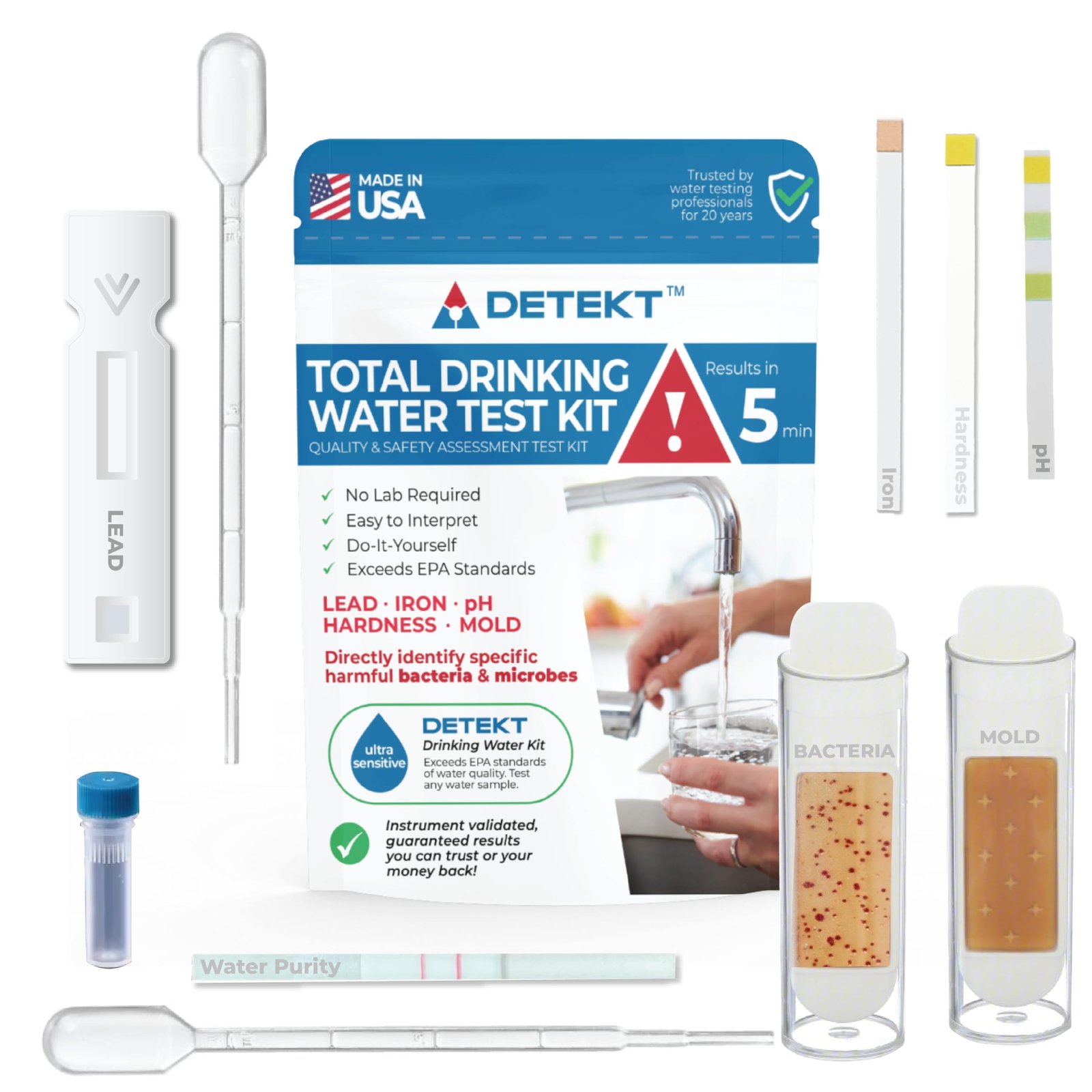
A water well test kit can be a useful first look at your home’s water, but its value depends on what it tests, how the sample is collected, and what you do with the result. Some kits provide quick screening information for common concerns such as hardness, pH, iron, nitrate, or bacteria. Others are simply containers and instructions for sending a sample to a certified laboratory.
For private well owners, the most reliable approach is usually to use a kit as part of a testing plan—not as proof that water is safe or unsafe. A clear, odor-free sample can still contain contaminants that cannot be seen or tasted, while an alarming color strip may need laboratory confirmation before you spend money on treatment.
This guide explains how to choose a water well test kit, what different kit types can and cannot tell you, and when a certified laboratory test is the better next step.
What Is a Water Well Test Kit?
A water well test kit is a collection of sampling materials, test strips, reagents, vials, or containers used to check water quality. It may provide results at home within minutes, or it may help you collect and ship a sample to a laboratory for professional analysis.
Not all kits serve the same purpose. The term can describe several very different products:
- At-home screening kits: Usually include color strips, drops, or test tablets for measurements such as pH, hardness, nitrate, nitrite, iron, chlorine, copper, or total dissolved solids.
- Bacteria presence/absence kits: Designed to screen for indicators of bacterial contamination. Results may take longer than strip tests and require careful sample handling.
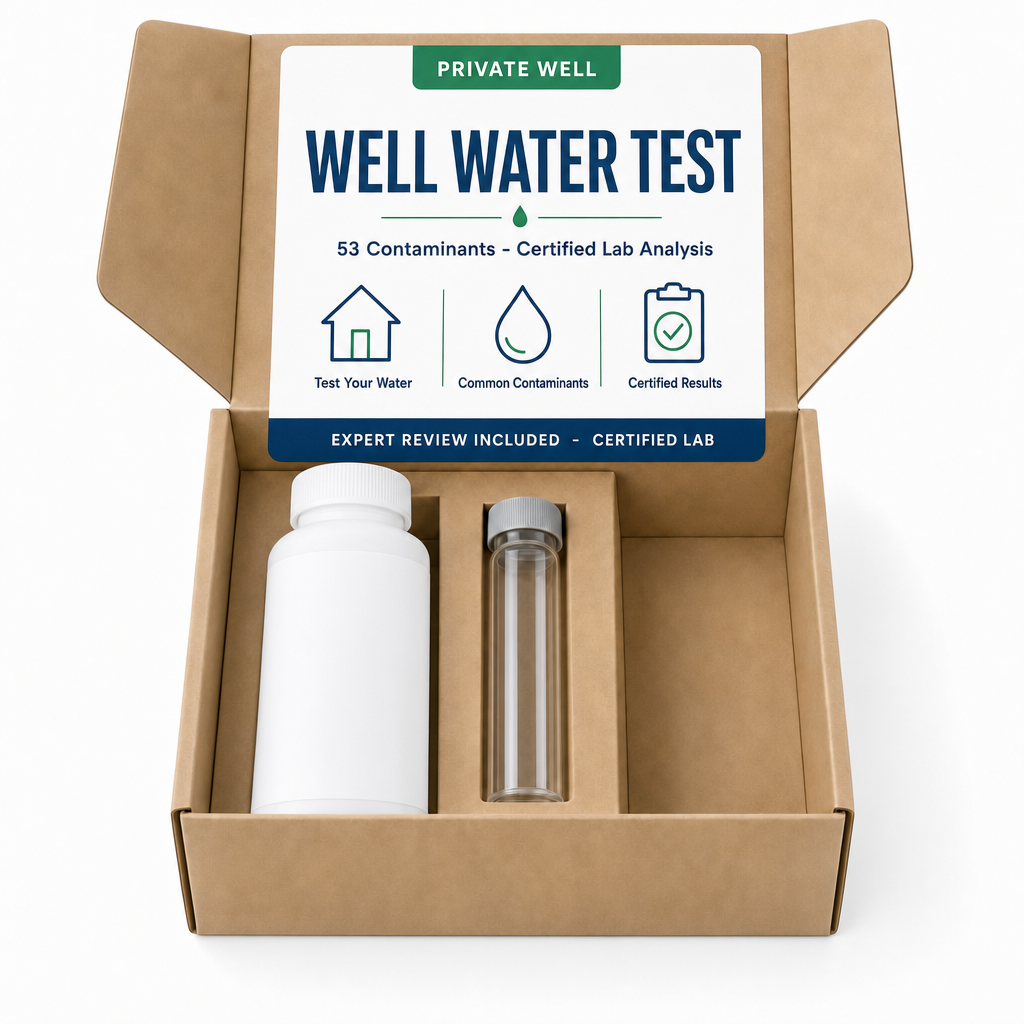
- Mail-in laboratory kits: Include sterile bottles, shipping materials, forms, and collection instructions for a certified lab.
- Single-parameter kits: Focus on one concern, such as lead, nitrate, arsenic, radon, or bacteria.
A kit’s usefulness is tied to the analytes it measures. A pH strip may help explain corrosion risk, for example, but it cannot determine whether the water contains arsenic, E. coli, or an unsafe level of nitrate.
What a Home Test Kit Can and Cannot Tell You
Home testing can help a homeowner recognize patterns, prioritize concerns, and decide whether laboratory testing is warranted. It is especially helpful when water quality changes suddenly or when you want basic information before selecting a treatment system.
What screening kits may be useful for
Depending on the product, an at-home water well test kit may provide approximate readings for:
- Hardness: Helps identify calcium and magnesium levels that contribute to scale and soap performance issues.
- pH: Indicates whether water is acidic, neutral, or alkaline. Low pH can contribute to corrosion and metal leaching in plumbing.
- Iron and manganese: May help investigate orange, brown, black, or gray staining and metallic taste.
- Nitrate and nitrite: Important screening targets where agricultural activity, septic systems, shallow groundwater, or nearby land use may affect the well.
- Chlorine: Relevant after disinfection or when evaluating treated water, although chlorine is not normally expected in an untreated private well.
- Total dissolved solids (TDS): A broad measure of dissolved material that can indicate a change in water chemistry, but does not identify specific contaminants.
These results can be useful conversation starters with a water treatment professional, local health department, or laboratory. They may also help you compare untreated water with water after a softener, filter, or reverse osmosis system.
What a kit cannot establish on its own
Most consumer kits cannot provide the certainty needed to make a health decision. A negative home result does not prove the absence of contaminants, and a positive result may need confirmation with an appropriate laboratory method.
In particular, do not assume a basic strip kit can reliably establish drinking-water safety for:
- Coliform bacteria or E. coli
- Arsenic
- Lead
- PFAS and other industrial or household chemicals
- Pesticides and herbicides
- Volatile organic compounds
- Radon in water
- Specific dissolved salts or metals not listed on the kit
Smell, taste, color, TDS, and many strip-test results are not complete safety assessments. Do not taste water to investigate a suspected contaminant. If you believe the well may be affected by sewage, fuel, chemicals, flooding, or another potentially harmful source, use a known safe water source and contact your local health department or a qualified laboratory promptly.
Choosing the Right Type of Well Water Test
The best water well test kit starts with the question you need answered. Buying the largest kit available is not always the best choice, especially if it omits local contaminants of concern or provides only broad screening results.
| Situation | Useful Testing Focus | Best Starting Option |
|---|---|---|
| Newly purchased home with a private well | Bacteria, nitrate, basic chemistry, and locally relevant contaminants | Certified laboratory package selected for the area |
| Rotten-egg odor | Sulfur-related conditions, bacteria, iron, manganese, and source of odor | Lab testing or a targeted kit followed by confirmation |
| Orange or black staining | Iron, manganese, pH, hardness, and sediment | Screening kit for initial insight; lab test before treatment selection |
| Cloudy water after storms or repairs | Coliform bacteria, turbidity or sediment, and possible changes in chemistry | Laboratory bacteria test and local guidance |
| Choosing a water softener | Hardness, iron, manganese, pH, and household water use | Lab water analysis or a quality hardness screen confirmed as needed |
| Concern about a specific nearby hazard | Contaminant tied to the hazard, such as nitrate, arsenic, lead, or chemicals | Targeted certified laboratory test |
Consider your local risks
Private wells are not regulated in the same way as public water systems, so the homeowner is generally responsible for testing and maintenance. Regional geology, land use, well construction, and nearby activities all matter.
For example, arsenic can occur naturally in some groundwater areas. Nitrate concerns may be higher near agricultural land, septic systems, or areas with vulnerable shallow groundwater. Flooding, a damaged well cap, recent well work, or a change in water quality can create reasons to test for bacteria.
Your local or state health department, university extension service, or a certified drinking-water laboratory may be able to suggest an appropriate panel for your county. The U.S. Environmental Protection Agency also provides private-well guidance at https://www.epa.gov/privatewells/protect-your-homes-water.
Read the kit label before buying
Before choosing a kit, review the product details carefully. Look for these practical details:
- The exact contaminants or measurements included
- The measurement range and units reported
- Whether the kit is a screening tool or uses laboratory analysis
- Whether lab fees and shipping are included
- Sample holding times and shipping requirements
- Whether sterile collection bottles are supplied for bacteria testing
- Whether the test method is appropriate for private well water
- Whether results identify detection limits or provide a detailed report
Be cautious with broad claims such as “tests for everything” or “guarantees safe water.” No single household test product covers every possible well-water concern.
At-Home Kits vs. Certified Laboratory Testing
At-home kits and laboratory tests are not direct substitutes. Each can be valuable when used for the right purpose.
Credit: midatlanticwater.net
When an at-home kit makes sense
A home kit may be a reasonable first step when you want to:
- Check approximate hardness before researching softening options
- Compare untreated water with treated water
- Monitor a known non-health-related issue, such as pH or iron staining, between lab tests
- Investigate an unexpected change in color, odor, or scale formation
- Decide which laboratory tests may be worth ordering
Color-comparison tests work best when used exactly as directed and read under suitable lighting. Expired reagents, contaminated containers, incorrect timing, and subjective color matching can all affect the result.
When laboratory testing is the better choice
Use a certified laboratory when results may affect drinking-water decisions, real estate transactions, treatment design, or the health of people in the household. Laboratory testing is also the stronger choice when you need a result for a contaminant that is difficult to measure accurately with a consumer kit.
Laboratory testing is particularly important for bacteria, nitrate, arsenic, lead, and any contaminant tied to a known local risk. It is also appropriate after flooding, a well repair, a broken or missing well cap, or a major unexplained water-quality change.
A lab report should identify what was tested, the reported units, the analytical method or reporting limit, and the result for the submitted sample. Remember that a result applies only to the sample collected, the analytes requested, and the test’s detection capability. It does not certify that all water from the well will always have the same quality.
How to Collect a Useful Water Sample
Sample collection matters as much as the test itself. A poorly collected sample can represent plumbing conditions, a dirty faucet aerator, a treatment device, or handling contamination rather than the water you intended to test.
Always follow the instructions included with the exact kit or laboratory bottle. Laboratories may require different containers, preservatives, collection points, timing, and delivery procedures for different analytes. Do not substitute a general sampling method for the lab’s instructions.
Choose the correct sampling point
First decide what you need the sample to represent:
- Raw well water: Collected before a softener, filter, UV unit, or other treatment equipment. This is useful for diagnosing source-water conditions and planning whole-house treatment.
- Treated household water: Collected after a specific treatment device. This can help evaluate whether that device is addressing the contaminant it was intended to reduce.
- Water at a drinking tap: Useful when the concern relates to water people actually consume, including possible plumbing-related metals.
Label the sample location clearly. “Kitchen sink” alone may not be enough information if the home has a water softener, carbon filter, reverse osmosis system, or another device between the well and the faucet.
Follow special requirements for bacteria samples
Bacteria sampling is especially sensitive to collection technique. Use only the sterile container supplied or specified by the laboratory. Do not rinse it, touch the inside of the cap or bottle, or transfer water from another container. Follow the laboratory’s directions for faucet preparation, filling, storage, and prompt delivery.
If a bacteria sample is mishandled or delivered outside the required time window, the laboratory may reject it or the result may not be meaningful. A positive total coliform result is not automatically the same as a positive E. coli result, but either finding should be taken seriously and discussed with local health officials or a qualified well professional.
Understanding Common Results
Test reports can be difficult to interpret because the significance of a result depends on the analyte, unit, source, household plumbing, and the reason for testing. Avoid choosing treatment based on one number without considering the full water profile.

Credit: amazon.com
Hardness
Hardness is usually caused by dissolved calcium and magnesium. It is mainly a household performance concern rather than a direct safety measure. Hard water can contribute to scale on fixtures and appliances, reduce soap lather, and affect water heater efficiency over time.
If you are considering an ion-exchange water softener, a laboratory analysis that includes hardness, iron, manganese, and pH is more useful than hardness alone. Iron and manganese can affect softener sizing, maintenance, and whether pretreatment may be needed.
pH
pH describes how acidic or alkaline water is. It does not measure all corrosive conditions, but low pH can be associated with corrosion risks in certain plumbing systems. If metals appear in water, testing both the source water and water at the tap may help distinguish a well-water issue from plumbing-related leaching.
Iron and manganese
Iron often causes orange or reddish-brown staining. Manganese may produce dark brown, black, or gray staining. Both can affect water appearance, taste, laundry, fixtures, and treatment equipment.
However, staining alone does not confirm the concentration or form of either mineral. A laboratory test helps determine whether a sediment filter, oxidation system, softener, or another approach is appropriate. Treatment should be selected for the measured water chemistry and required household flow rate.
Nitrate and nitrite
Nitrate and nitrite are health-related analytes that require careful interpretation. Reports may express nitrate in different ways, including nitrate as nitrogen or nitrate as nitrate. These are not interchangeable reporting formats, so review the units and reporting basis before comparing results with health guidance.
If testing identifies a concerning nitrate or nitrite result, use a known safe water source for drinking and food preparation while you seek direction from your local health department or qualified water professional. Boiling water does not remove nitrate and can increase its concentration as water evaporates.
Total dissolved solids
TDS is a measurement of the combined dissolved substances in water. A TDS meter does not identify which minerals, salts, or contaminants are present. A low reading does not prove water is safe, and a higher reading does not by itself identify a health hazard.
TDS can be useful for noticing changes over time, especially if you measure at the same location under similar conditions. Treat it as a trend indicator, not a complete well-water analysis.
When to Test a Private Well
Routine testing helps establish a baseline and reveal changes before they become expensive equipment problems or possible health concerns. The exact schedule should reflect local recommendations and known regional risks.
Many public-health agencies recommend that private well owners test for total coliform bacteria and nitrate at least annually, while other contaminants may be tested less frequently or when local conditions indicate a need. Ask your health department which tests are most relevant where you live.
Additional testing is sensible after:
- Flooding or standing water around the well
- Well repairs, pump replacement, or other work that opens the system
- A damaged, loose, or missing well cap
- A sudden change in odor, color, taste, sediment, or pressure
- Nearby construction, spills, agricultural changes, or septic problems
- Installation or failure of water treatment equipment
- A household member’s medical provider recommending a specific test
Changes in water pressure may involve the pump, pressure tank, plumbing restriction, or treatment equipment rather than water quality. Still, if pressure changes occur alongside discoloration, sediment, or odor, documenting both symptoms can help identify the appropriate next test or inspection.
Common Mistakes to Avoid
- Using a TDS meter as a safety test: It cannot identify bacteria, arsenic, lead, nitrate, or most specific chemicals.
- Testing only after treatment: If you are diagnosing a well-water problem or designing treatment, raw water results are often essential.
- Ordering a generic panel without checking local risks: A broad package may still omit a contaminant important in your area.
- Ignoring sample instructions: Incorrect containers, delayed shipping, and improper collection can invalidate results.
- Buying treatment before confirmation: A filter that improves odor or staining may not address the actual contaminant or any separate health concern.
- Assuming an aesthetic improvement means safe water: Clear, pleasant-tasting water can still require laboratory testing for invisible contaminants.
- Comparing results without checking units: This is particularly important for nitrate reporting and metal results.
How to Use Results to Make a Practical Decision
After receiving results, separate the findings into three groups: health-related contaminants, aesthetic or household issues, and results that need clarification. This prevents a common mistake: spending money on a water softener or sediment filter while overlooking a contaminant that requires a different response.
- Confirm health-related concerns. If a screening kit indicates bacteria, nitrate, lead, arsenic, or another potentially harmful contaminant, arrange a laboratory test appropriate to that analyte.
- Identify where the issue occurs. Determine whether the result represents raw well water, treated water, or water from one tap. This helps distinguish a source-water issue from a treatment or plumbing issue.
- Review the full water chemistry before treatment. Iron, manganese, hardness, pH, and sediment can affect which systems work well together.
- Match equipment to the verified problem. Sediment filtration, activated carbon, softening, iron or sulfur treatment, UV disinfection, and reverse osmosis address different concerns and have different maintenance needs.
- Retest when appropriate. Confirmation testing after installation, repair, or a treatment change can show whether the chosen solution is performing as intended.
A water well test kit is most valuable when it leads to a clearer next step: a targeted laboratory analysis, an inspection of the well and treatment equipment, or a treatment decision based on verified water conditions.

Credit: qualitywatertreatment.com
Frequently Asked Questions
How long do water well test kit results take?
At-home strip or drop tests may produce a reading within minutes, while bacteria presence/absence tests can take longer. Laboratory turnaround varies by analyte, lab workload, and shipping time. Check the specific kit or laboratory instructions before collecting the sample, especially when a sample has a short holding time.
Can I use a pool water test kit for my well?
No. Pool kits are designed mainly for pool-management measurements such as chlorine and pH. They are not a substitute for drinking-water testing for bacteria, nitrate, metals, or other well-water concerns.
Should I test before or after my water softener?
It depends on your goal. Test before the softener when evaluating raw well water or sizing treatment. Test after the softener when checking treated water performance. In some situations, collecting both samples provides the clearest comparison.
Can a water well test kit detect a failing septic system?
A kit cannot diagnose a septic system failure by itself. Bacteria or nitrate findings may indicate a reason for further investigation, but they can also come from other sources. A local health department, well professional, or septic professional can help evaluate the site conditions and choose follow-up testing.
Do I need to retest water after replacing a filter?
Retesting can be useful when the filter was installed to address a verified contaminant or when you need to confirm performance. Use a test that measures the specific problem the filter is intended to reduce, and collect the sample from the correct location according to laboratory instructions.