
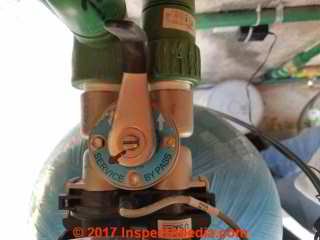
A water softener bypass valve lets you direct household water around the softener without shutting off water to the entire home. It is a simple component, but it matters during maintenance, repairs, extended absences, and any time you need untreated water flowing through the plumbing.
When the valve is in service, water passes through the softener’s resin tank, where hardness minerals such as calcium and magnesium are exchanged for sodium or potassium. When the valve is in bypass, water reaches the home without being softened.
Knowing which position your valve is in can prevent confusing problems, including suddenly hard water, salty-tasting water during a service issue, reduced flow after maintenance, or a softener that appears to be working while the home is receiving untreated water.
What a Water Softener Bypass Valve Does
A water softener bypass valve creates an alternate path for water around the treatment equipment. It is normally installed where the home’s main cold-water supply enters and exits the softener.
In normal operation, untreated well water enters the softener, flows through the resin media, and then leaves as softened water for the home. In bypass mode, the inlet and outlet are connected so water can continue to flow to the house without entering the softener.
The valve does not remove hardness on its own, regulate pressure, or repair a malfunctioning softener. Its role is to isolate the softener while preserving basic water service to the home.
Why bypass capability is important
- It allows the softener to be serviced without turning off all household water.
- It provides water while a technician repairs or replaces the unit.
- It can help isolate whether a pressure or flow problem is caused by the softener or another part of the plumbing system.
- It prevents water from entering the softener during certain maintenance tasks, when the manufacturer’s instructions call for isolation.
- It can be useful if a leak develops at the softener, brine tank, drain connection, or control valve.
Water sent through bypass is usually still safe only to the extent that the untreated source water is safe. A bypass valve is not a treatment method. If laboratory testing identifies a health-related contaminant, do not assume bypassed well water is suitable for drinking, cooking, bathing, or other uses. Follow guidance from your local health department and address the specific hazard.
How Water Moves in Service and Bypass Modes
Understanding the water path makes valve positions easier to recognize. Most installations have three functional paths: an inlet line from the well pressure system, an outlet line leading to the home, and the softener itself between those two connections.
| Valve position | Water path | What reaches household fixtures |
|---|---|---|
| Service | Water enters the softener, passes through the resin, then exits to the home. | Softened water, assuming the unit is operating and correctly sized. |
| Bypass | Water travels directly from the incoming line to the outgoing house line. | Untreated water with the source water’s normal hardness and other characteristics. |
| Partial bypass or incorrect position | Water may be restricted, mixed, or routed improperly depending on the valve design. | Results can include low flow, inconsistent softness, or hard water. |
When a softener is bypassed, hard-water symptoms may return quickly. You may notice spotting on dishes, reduced soap lather, scale buildup, rough-feeling laundry, or a change in water feel. The timing depends on how much softened water remains in the home’s plumbing and water heater.
Common Types of Water Softener Bypass Valves
The correct way to operate a bypass depends on the valve style. Before moving anything, identify the manufacturer’s markings and trace the water lines. Do not rely only on handle direction, because a handle that is parallel or perpendicular to a pipe can mean different things on different arrangements.
Built-in push-button or lever bypass
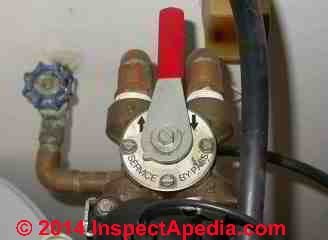
Many modern softener control heads have an integrated bypass assembly attached directly to the back of the valve. It may use two knobs, sliding handles, push-pull stems, or levers. One position routes water through the softener; another connects inlet to outlet externally.
These units are compact and convenient, but the labels can vary. Look for markings such as “service,” “bypass,” “in,” “out,” arrows, or symbols molded into the bypass body. Consult the manual for the exact control valve if the position is unclear.
Three-valve plumbing bypass
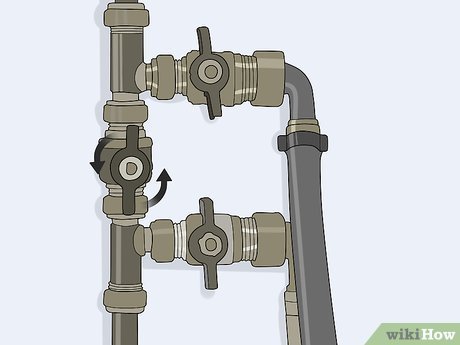
A traditional plumbing bypass uses three separate shutoff valves:
- An inlet valve before the softener
- An outlet valve after the softener
- A connecting bypass valve between the inlet and outlet lines
In normal service, the inlet and outlet valves are open while the center bypass valve is closed. To bypass the softener, the inlet and outlet valves are closed and the bypass valve is opened.
This configuration is common with older installations and may be built from ball valves, gate valves, or other plumbing valves. Ball valves are often easier to identify because their handles typically align with the direction of an open pipe and cross the pipe when closed. Still, confirm the actual piping arrangement rather than assuming.
Single-handle or multiport bypass assemblies
Some softeners use a separate factory-made bypass with one large handle or a multiport valve body. Turning or moving the handle changes the internal flow path. These are designed to make switching between service and bypass easier, but they may have intermediate positions that should not be used for regular operation.
If the system has a multiport assembly, move it deliberately to the fully marked position. A partly moved handle can restrict water flow or leave the softener only partly isolated.
When to Put a Water Softener in Bypass
Bypass is useful when the softener needs to be taken out of the water path. It is not generally the best setting for daily use if the system is needed to control hardness.
Credit: inspectapedia.com
During repairs or replacement
Put the system in bypass before a qualified technician disconnects the softener, replaces a control valve, repairs plumbing connections, or investigates a suspected leak. The bypass can keep water available at sinks and toilets while the softener is isolated.
If water is actively leaking, first protect people and property. Turn off the water supply if the bypass cannot stop the leak, and avoid operating electrical equipment near standing water. A leak at a softener may come from a fitting, drain line, brine line, control valve, tank connection, or nearby plumbing, so do not assume the resin tank itself has failed.
When diagnosing pressure or flow problems
A bypass valve can help narrow down a whole-house low-flow problem. If water pressure or flow improves noticeably with the softener bypassed, the softener or its plumbing may be creating a restriction. Possible causes include fouled resin, sediment buildup, an undersized softener, a clogged prefilter, a malfunctioning control valve, or a partially closed valve.
However, bypass results do not prove the exact fault. Low pressure can also involve the well pump, pressure tank, pressure switch or controller, a clogged sediment filter, a plumbing restriction, or excessive household demand. Water pressure and flow rate are related but not identical: pressure is force, while flow is the volume of water delivered over time.
When the softener malfunctions
Bypass may be appropriate if the softener is stuck in regeneration, leaking internally, producing unusually salty water, or otherwise behaving abnormally. Do not keep using a unit that is sending water to an improper drain connection or causing visible leaks.
Salty water can result from several issues, including incomplete rinsing after regeneration, a control-valve problem, incorrect programming, or a system that needs service. Bypassing the unit may stop further softened-water use, but it does not identify the cause. Follow the manufacturer’s service guidance or contact a qualified water-treatment professional.
During some maintenance tasks
Manufacturers may recommend bypassing the softener before certain maintenance, such as replacing components, cleaning a brine tank, or servicing the control valve. Follow the instructions for your exact model. Routine salt addition does not always require bypass, but it is still wise to avoid disturbing plumbing connections or controls unnecessarily.
How to Put a Water Softener in Bypass Safely
Changing a bypass position is usually a straightforward plumbing task, but do not force seized handles or attempt to disassemble pressurized fittings. If the valve is leaking, badly corroded, cracked, or difficult to move, stop and arrange service.
- Check whether the softener is regenerating. If it is in a regeneration cycle, consult the manufacturer’s instructions before changing valve positions. Interrupting a cycle incorrectly may leave the unit in an unsuitable state.
- Identify the inlet, outlet, and bypass controls. Look for labels, arrows, or a plumbing diagram. The incoming line should come from the pressure tank or main water supply; the outgoing line leads to the home.
- Open a nearby cold-water faucet briefly. This provides a simple way to observe whether water remains available after the change. It may also reduce pressure changes in the plumbing.
- Move the valve fully to the marked bypass position. On a three-valve setup, close the softener inlet and outlet valves, then open the center bypass valve. On an integrated unit, use the manufacturer-labeled bypass position.
- Check water flow at a cold-water fixture. Flow may sputter briefly as air moves through the lines. Let it run until it is steady.
- Inspect for leaks. Look around the bypass, fittings, and softener connections. Do not overtighten plastic fittings or attempt repairs while the system is pressurized unless you are qualified to do so.
After the softener is bypassed, the home is receiving untreated water. If your well water has hardness, iron, manganese, sulfur odor, or other known water-quality issues, those conditions may return. If the water has a suspected health concern, use a known safe source as advised by local officials rather than treating bypass as a temporary safety solution.
How to Return the Softener to Service
Once maintenance or repairs are complete, restore the valve to service only after confirming that the softener is ready for normal operation. Make sure any required hoses, drain connections, and fittings are properly installed according to the manufacturer’s instructions.
For a typical three-valve bypass, close the center bypass valve first, then open the softener’s inlet and outlet valves. Opening the valves gradually can reduce sudden flow changes. For an integrated bypass, move the controls completely to the service position.
Then check a cold-water fixture and inspect connections for leaks. If the softener has been disconnected, emptied, re-bedded, or repaired internally, the manufacturer may require a specific startup, rinse, or regeneration procedure. Do not guess at regeneration settings, salt doses, or programming values. They should match the water test results, system capacity, and model instructions.

Credit: dropconnect.com
Signs the Bypass Valve May Be in the Wrong Position
Many homeowners discover a bypass problem only after noticing that the water suddenly feels different. A valve may have been left in bypass after a repair, only partly returned to service, or accidentally moved while working near the equipment.
Hard-water symptoms return throughout the home
If all fixtures begin showing hard-water symptoms after plumbing work or softener maintenance, inspect the bypass position before assuming the softener needs new resin or replacement. Common signs include:
- Soap that does not lather as easily
- White scale on faucets, shower doors, or appliances
- Spots on glassware after washing
- Stiff-feeling laundry
- A less slippery feel after washing hands or showering
These symptoms suggest that untreated hard water may be reaching the home, but they do not confirm the cause. The softener could also be out of salt, programmed incorrectly, undersized for the household, exhausted between regenerations, or affected by iron or sediment fouling.
Low flow appears after a valve change
Restricted flow after service can mean one or more valves are not fully open. On a three-valve arrangement, a partially closed inlet, outlet, or bypass valve can limit water delivery. An incorrectly positioned built-in bypass can have a similar effect.
If low flow affects only one faucet, look first at that fixture’s aerator, cartridge, shutoff valves, or local plumbing. If it affects the whole home, check the pressure gauge, any sediment filter, and the softener bypass position before concluding that the well pump is failing.
Water is partly softened or inconsistent
Water that seems soft at some times and hard at others can result from a partially positioned bypass, a mixing valve, a regeneration issue, variable household demand, or a softener that cannot keep up with the actual hardness load. A hardness test on untreated and treated samples can help establish whether the softener is providing meaningful hardness reduction.
For useful results, collect samples from appropriate locations and follow the test provider’s instructions. A water softener changes hardness but is not designed to make all well-water contaminants safe. Testing should match the concern, such as hardness, iron, manganese, bacteria, nitrate, arsenic, or pH.
Common Bypass Valve Problems
Leaking around handles or connections
A small drip may come from worn seals, O-rings, cracked plastic parts, loose fittings, or stress on poorly supported plumbing. Do not use sealants as a universal fix, especially on components designed with replaceable seals. The right repair depends on the exact valve and connection type.
Place the softener in bypass if that stops water from reaching the affected equipment, then arrange repair. If the bypass valve itself leaks or cannot isolate the system, the home’s main water shutoff may be necessary.
Stiff or seized valve handles
Mineral scale, corrosion, age, or infrequent use can make manual valves difficult to turn. Forcing a handle can break the valve body or damage connected plumbing. If gentle operation does not work, leave it in its current position and call a plumber or water-treatment technician.
Periodically checking the valve’s movement during ordinary maintenance can reveal a problem before an urgent repair makes bypass necessary.
Internal crossover or failed seals
Some integrated bypass assemblies can develop internal seal problems. In that case, water may leak externally, pass through the softener when it should be bypassed, or bypass the softener when it should be in service. The exact symptoms depend on the valve design.
Unexpected hardness, unexplained water use, poor softener performance, or changes in flow may justify inspection by a technician. Replacing seals or the bypass assembly can be model-specific, so use the correct parts and instructions rather than selecting parts by appearance alone.
Installation and Placement Considerations
A bypass should be accessible, clearly identifiable, and installed in the correct direction of flow. It should be located where the softener can be isolated without disrupting essential plumbing more than necessary.
In a typical private-well home, the softener is installed after the pressure tank and usually after any treatment equipment that must protect the softener, such as a sediment filter or an iron-treatment system. The exact sequence depends on the water test, treatment design, pressure loss, required flow rate, and equipment specifications.
Not every line necessarily needs softened water. Some homes have outdoor spigots, irrigation lines, or other branches intentionally supplied with untreated water to reduce salt use and avoid unnecessary treatment. Whether that arrangement makes sense depends on the plumbing layout, local conditions, and the homeowner’s needs.
A bypass should not create cross-connections that interfere with other treatment equipment or allow untreated water to mix into lines intended to receive treated water. If you are installing a new softener, modifying main plumbing, or adding multiple treatment stages, a qualified installer can verify flow direction, drain requirements, shutoff access, and code-compliant connections.
Credit: wikihow.com
FAQ
Can I leave my water softener in bypass for several days?
Yes, provided the plumbing is not leaking and untreated water is acceptable for the intended household uses. Expect hard-water effects to return, including scale and spotting. If your well has a known health-related water-quality concern, do not assume untreated bypass water is safe; use the guidance provided for that specific concern.
Does bypassing a softener turn off the water supply?
No. A properly functioning bypass is meant to keep water flowing to the house while routing it around the softener. If water stops completely after changing the valve position, a valve may be closed incorrectly, the bypass may be misidentified, or there may be another plumbing issue.
Will appliances be damaged if they receive bypassed hard water?
Short-term bypass use is not usually an emergency, but hard water can contribute to scale buildup over time in water heaters, dishwashers, washing machines, and fixtures. The extent depends on the measured hardness, water use, temperature, and length of time the softener remains bypassed.
Why is my water still soft when the bypass is on?
Softened water may remain in the plumbing and water heater for a while. If the condition continues after sufficient water use, the bypass may not be fully engaged, the valve may have an internal crossover, or the incoming water may not be very hard. Testing raw and treated water can help clarify what is happening.
Can I install a bypass valve on an older water softener?
Often, yes. A plumber or qualified water-treatment professional can add a compatible bypass arrangement if the existing plumbing allows it. The best choice depends on pipe material, available space, flow direction, softener connections, shutoff access, and whether other treatment equipment is installed nearby.