

A rotten egg smell in water is usually caused by hydrogen sulfide gas. It can occur naturally in private well water, develop in plumbing, or be produced by bacteria in a water heater. Although the odor is unpleasant, it does not by itself identify the source or prove whether the water is safe to drink.
The most useful clue is where and when the smell appears. Water that smells on both the hot and cold sides throughout the house points to a different issue than an odor limited to hot water or one bathroom sink. A few simple observations, followed by the right water test or plumbing inspection, can prevent homeowners from buying treatment equipment that does not solve the actual problem.
Do not drink, cook with, or otherwise rely on water with a sudden unexplained change in odor until you understand the cause. If the smell appeared after flooding, well work, a damaged well cap, sewage problems, or a loss of water pressure, use a known safe water source and contact your local health department or a qualified well professional.
What Causes a Rotten Egg Smell in Water?
The classic sulfur or rotten egg odor comes from hydrogen sulfide (H2S), a gas that can dissolve in groundwater. When water is poured into a glass, heated, or agitated in a shower, the gas escapes more easily and the smell becomes stronger.
Hydrogen sulfide can enter a residential water system in several ways. The right fix depends on which one applies.
Naturally occurring hydrogen sulfide in well water
In some groundwater aquifers, natural chemical conditions allow sulfur compounds to convert into hydrogen sulfide gas. This is especially common in water that has limited oxygen underground. The odor may be present in untreated water at every fixture, including both hot and cold taps.
Natural hydrogen sulfide often occurs alongside other well-water issues, such as iron, manganese, low pH, or sediment. Those conditions matter because a treatment system that handles odor alone may not be suitable for the rest of the water chemistry.
Sulfur-reducing bacteria in the well or plumbing
Some bacteria use sulfur compounds as part of their normal activity and can produce hydrogen sulfide. These bacteria are not automatically the same as disease-causing bacteria, but their presence can contribute to odor, slime, clogged equipment, and corrosion concerns.
Sulfur-related bacteria may grow in a well, pressure tank, plumbing, filter housing, or other areas where water sits for long periods. The odor can become more noticeable after the home has been vacant, after low water use, or when water first runs in the morning.
A water heater problem
If the rotten egg smell occurs only when hot water runs, the water heater is a leading suspect. Some water heaters can create conditions that encourage odor-producing bacteria. In certain water conditions, the heater’s sacrificial anode rod may also contribute to a sulfur-like smell.
This does not necessarily mean the water heater is failing. It does mean that whole-house well treatment may not be the first or only solution. A licensed plumber can evaluate the heater, its maintenance condition, and whether an anode-related change is appropriate for that specific unit.
Drain odors mistaken for water odors
A sink drain can contain biofilm and decomposing organic material that smells sulfurous. In this case, the water itself may be normal. A common clue is that the smell is strongest when the faucet runs into the drain, but a glass of water taken away from the sink does not have the same odor.
Cleaning the drain and overflow opening may solve a drain odor. However, do not assume the drain is the cause merely because the smell is strongest in a bathroom or kitchen. Check the water away from the fixture before ruling out the well or plumbing.
Contamination that needs prompt attention
A rotten egg smell is most often an aesthetic or plumbing-related issue, but it should not be used to rule out contamination. Sewage contamination, damaged well components, flooding, surface-water intrusion, or nearby wastewater problems can introduce harmful microorganisms and other contaminants.
A sulfur odor cannot confirm sewage contamination, and the absence of an odor cannot confirm safety. If the smell is sudden, severe, or accompanied by cloudy water, unusual color, illness in the household, or recent flooding, arrange appropriate laboratory testing and seek local guidance promptly.
Use the Smell Pattern to Narrow Down the Source
Before choosing a treatment method, note whether the odor occurs in hot water, cold water, one fixture, or the entire house. These observations do not diagnose the problem, but they help identify the next sensible step.
| What you notice | Possible explanation | Useful next step |
|---|---|---|
| Smell in both hot and cold water at multiple fixtures | Hydrogen sulfide in untreated well water, bacteria in the well or plumbing, or a whole-house treatment issue | Compare untreated and treated water if applicable; arrange a water test and well-system evaluation |
| Smell only in hot water | Water heater conditions, bacteria, or an anode-related reaction | Have the water heater inspected before installing whole-house odor treatment |
| Smell at one sink, but not in a glass of water taken elsewhere | Drain biofilm or a local plumbing fixture issue | Clean the drain and overflow area; reassess the water itself |
| Smell after water sits unused | Stagnant plumbing water, bacterial growth, or gas accumulating in the system | Note whether it clears after flushing and whether the issue affects all fixtures |
| New odor after flooding, repairs, or well damage | Possible changes in groundwater or well integrity | Use safe water for consumption and contact a qualified professional or health department |
Test a glass away from the sink
To separate a drain smell from a water smell, fill a clean glass with cold water and move away from the sink before smelling it. Do not taste water to investigate an odor. If the smell remains in the glass, the issue is more likely in the water supply than in the drain.
Then compare cold and hot water in separate clean glasses. If only the hot-water sample smells, document that result for a plumber. If both samples smell, the well, plumbing, or existing treatment equipment deserves closer attention.
Check whether treated and untreated water differ
Homes with a water softener, iron filter, carbon filter, reverse osmosis system, or other equipment may have more than one sampling point. If possible, identify whether the odor is present before treatment, after treatment, or only at a particular fixture.
This distinction can reveal whether existing equipment is undersized, overdue for maintenance, improperly matched to the water chemistry, or simply not designed to remove hydrogen sulfide. For example, a sediment filter is intended to capture particles; it is not a dependable solution for dissolved hydrogen sulfide gas.
Why a Water Test Matters Before Choosing a Fix
Hydrogen sulfide odor is a useful symptom, not a complete diagnosis. The odor intensity does not reliably show the concentration of hydrogen sulfide or tell you whether bacteria, nitrate, arsenic, or another contaminant is present.
A certified drinking-water laboratory can help identify the relevant water chemistry. Depending on the situation, useful testing may include hydrogen sulfide or sulfur-related analysis, iron, manganese, pH, hardness, alkalinity, total coliform bacteria, E. coli, and other analytes recommended for local well conditions.

Credit: purewaternorthwest.com
When bacterial testing is especially important
Consider prompt total coliform and E. coli testing when an odor is new or unexplained, especially after:
- Flooding or standing water near the well
- Well repairs, pump work, or a damaged well cap
- Changes in water clarity, color, taste, or pressure
- A nearby septic, sewer, or drainage problem
- Periods when the well or plumbing was unused
Follow the laboratory’s sampling instructions exactly. Microbiological samples often have strict container, handling, and delivery requirements. A result applies only to the sample collected, the analytes tested, and the laboratory method used.
Do not rely on a TDS meter or home screening strip
A TDS meter measures the electrical conductivity associated with dissolved material. It cannot identify hydrogen sulfide, harmful bacteria, arsenic, nitrate, or most specific contaminants. Likewise, a basic home test strip may be useful for a rough screening of selected parameters, but it cannot replace targeted laboratory testing when water quality has changed.
For general private-well guidance, the U.S. Environmental Protection Agency provides resources on protecting home well water. State and county health departments can also help homeowners locate certified laboratories and understand local groundwater risks.
How to Get Rid of Rotten Egg Smell in Well Water
The best way to remove a rotten egg smell in water is to treat the verified source. A water heater repair will not correct hydrogen sulfide entering from the well, while a large whole-house treatment system may be unnecessary if the odor comes only from one drain or the hot-water side.
Address water heater-related odor
When only hot water smells, start with the water heater. A plumber can inspect the unit, evaluate sediment and maintenance needs, and determine whether bacteria or an anode rod interaction is likely. The appropriate response depends on the heater type, water chemistry, and manufacturer instructions.
Do not alter heater temperature settings beyond safe manufacturer guidance in an attempt to disinfect the system. Hot water can cause serious burns, and temperature changes may not address the underlying cause. Do not work on electrical or gas water-heater components unless you are qualified to do so.
Clean and maintain problem drains
If the water itself smells normal when sampled away from the sink, clean the drain, stopper, overflow opening, and nearby surfaces according to the fixture manufacturer’s guidance. Removing biofilm and trapped debris can resolve odors that seem to come from the water.
A recurring odor at one fixture may also indicate a plumbing trap, venting, or drainage issue. A plumber can assess these conditions if ordinary cleaning does not help.
Well and plumbing disinfection when bacteria are confirmed or suspected
Disinfection may be considered when qualified evaluation indicates bacterial growth in the well or plumbing system. This is not a one-size-fits-all task. Effective well disinfection depends on the well construction, plumbing layout, water chemistry, equipment, and the reason bacteria are present.
Do not use an improvised chemical recipe, pour unverified amounts of disinfectant into a well, or bypass treatment equipment. Improper disinfection can damage components, create chemical hazards, fail to reach the source of the problem, or leave contaminated water in parts of the plumbing.
A qualified well contractor can determine whether professional disinfection is appropriate and inspect for underlying causes such as a loose cap, damaged casing, surface drainage problems, or a poorly protected wellhead. Follow-up water testing is important because an odor improvement alone does not confirm a microbiological problem has been resolved.
Oxidation and filtration for hydrogen sulfide
Whole-house hydrogen sulfide treatment commonly relies on oxidation followed by filtration. Oxidation changes hydrogen sulfide into forms that can be filtered or otherwise removed. The process may use air injection, an oxidizing media, or another system designed for the specific water chemistry.
The correct equipment depends on hydrogen sulfide levels, water pH, iron and manganese concentrations, household flow demand, well yield, plumbing size, and the required service flow in gallons per minute (GPM). A system that works at a low flow rate may not control odor when several showers, appliances, and fixtures run at once.
Some systems need backwashing, a drain connection, electrical power, media service, or periodic cleaning. They can also cause pressure loss if undersized or poorly maintained. A treatment professional should size the system using laboratory results and realistic peak household demand rather than odor alone.
Activated carbon for limited applications
Activated carbon can reduce some taste and odor compounds, including low levels of hydrogen sulfide in certain applications. However, carbon is not automatically the best choice for strong sulfur odor or water with iron and manganese. Those minerals can foul the media, reduce performance, and create maintenance problems.
Carbon filters have finite capacity and require timely replacement or maintenance. They should not be selected simply because a filter is marketed for odor reduction. Verify what the exact product is designed to address and whether it is suitable for your tested water conditions.
Aeration may help, but it is not universal
Aeration exposes water to air so dissolved hydrogen sulfide can leave the water or be oxidized for later filtration. It can be effective in some well-water systems, but it requires proper system design. Released gas must be safely vented, and downstream filtration may still be needed.
Aeration is not a substitute for investigating a sudden odor change, bacterial contamination, or a damaged well. It also may not be sufficient where iron, manganese, high odor levels, or other chemistry complicates treatment.
Common Fixes That Often Miss the Real Problem
Several tempting solutions can provide temporary relief while leaving the source untreated. Avoid assuming that a stronger fragrance, a basic pitcher filter, or a water softener will solve every sulfur smell.
- Replacing a pump: A pump does not normally create hydrogen sulfide. Replacement may be necessary for unrelated mechanical problems, but odor alone is not evidence that the pump has failed.
- Installing a water softener for odor: An ion-exchange softener removes hardness minerals and may reduce limited amounts of dissolved iron under suitable conditions. It is not a primary hydrogen sulfide treatment system and can be negatively affected by sulfur-related bacteria.
- Using a sediment cartridge: Sediment filtration captures particles. Hydrogen sulfide is dissolved gas, so a cartridge alone is unlikely to solve the odor.
- Masking the smell with additives: Fragrances and household products do not make questionable water safe and should not be introduced into a drinking-water system without professional guidance.
- Boiling the water: Heating may make the odor seem different as gas escapes, but boiling does not address harmful chemical contaminants and is not a complete response to an unknown well-water problem.

Credit: angelwater.com
Preventing Sulfur Odors From Returning
Not every natural groundwater condition can be prevented, but good well protection and regular system maintenance can reduce the chance that bacteria, surface water, or neglected equipment adds to the problem.
Protect the wellhead
Keep the well cap secure and in good condition. The wellhead should be protected from flooding, runoff, lawn chemicals, animal waste, and physical damage. Avoid storing fuel, pesticides, solvents, or other potentially harmful materials near the well.
If the well cap is loose, cracked, missing a screen, or has been submerged, arrange a professional inspection. A properly maintained cap is important, but it cannot correct deeper construction or groundwater issues on its own.
Maintain treatment equipment on schedule
Filters, oxidizing media, aeration components, drain lines, and backwashing systems need the maintenance specified for the exact model. Delayed service can reduce odor control, lower water pressure, and encourage buildup inside equipment.
Keep a simple record of filter changes, regeneration or backwash issues, laboratory results, repairs, and odor changes. This history can help a contractor distinguish a source-water change from a treatment-system problem.
Retest after major changes
Test private well water routinely and after events that could affect water quality, such as flooding, repairs, extended vacancy, or a noticeable change in color, taste, or odor. If a new treatment system is installed, confirm its performance with testing that matches the problem it was intended to address.
For example, if bacterial contamination was a concern, an odor-free result is not enough; the appropriate bacteriological test is needed. If iron or manganese was part of the treatment design, those analytes should be checked rather than relying only on smell.
When to Call a Professional
Homeowners can safely observe where the smell occurs, inspect visible filter housings for obvious leaks, and collect samples according to laboratory instructions. More involved work should be left to qualified help.
Contact a licensed plumber, qualified well contractor, or water-treatment professional when:
- The odor is new, severe, or present throughout the home
- Water is also cloudy, discolored, oily-looking, or unusually foamy
- The well was flooded, damaged, opened for service, or affected by nearby excavation
- The pressure system is behaving abnormally or water supply has changed
- Hot-water odor persists after a water-heater evaluation
- You need a whole-house system sized for hydrogen sulfide, iron, manganese, or household flow demand
- Laboratory results show coliform bacteria, E. coli, or another health-related concern
Provide the professional with your laboratory report, the location of the odor, whether it occurs in hot or cold water, the age and type of existing treatment equipment, and any recent well or plumbing changes. That information makes diagnosis more efficient and helps avoid unnecessary equipment replacement.
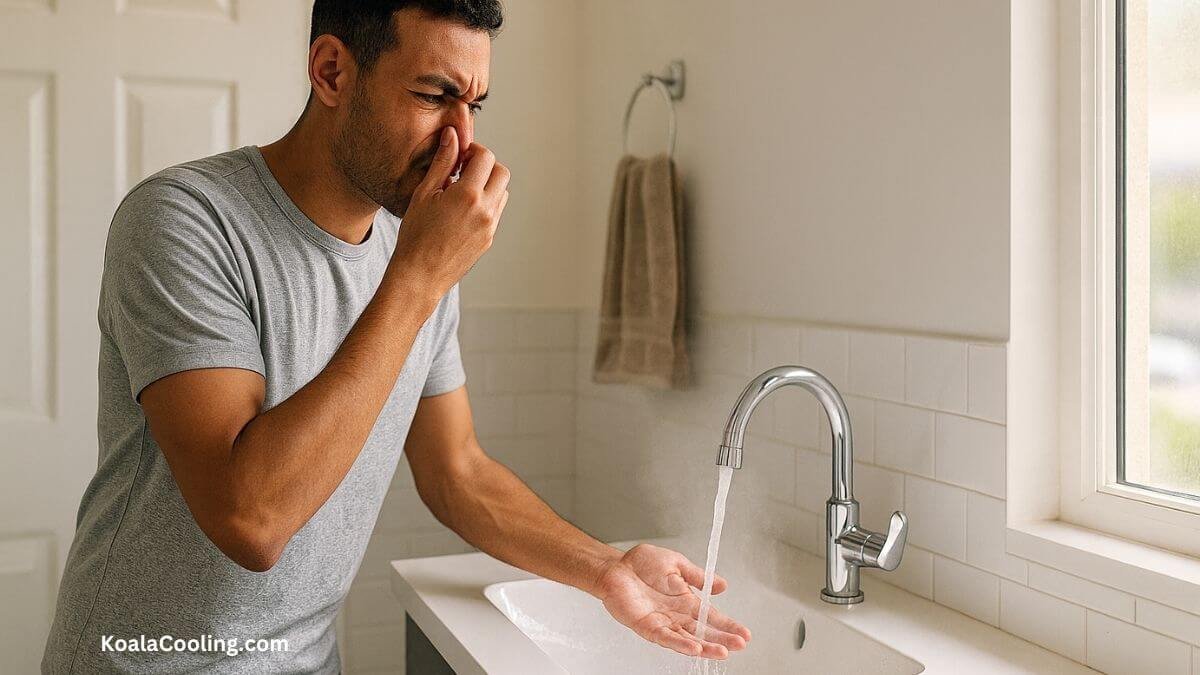
Credit: koalacooling.com
Frequently Asked Questions
Can hydrogen sulfide odor make a home smell even when faucets are off?
Yes. Hydrogen sulfide can be released while showering, washing clothes, running a dishwasher, or using hot water. The gas may linger in bathrooms, laundry rooms, or near drains, particularly in areas with limited ventilation. Persistent strong odors should be investigated rather than covered with air fresheners.
Why does the odor seem stronger after rain?
Rain can change groundwater conditions, increase surface runoff risks around a poorly protected well, or make drain and plumbing odors more noticeable. It does not automatically mean rainwater entered the well. If the pattern is new or follows flooding, have the wellhead inspected and consider appropriate water testing.
Will a reverse osmosis system remove sulfur odor?
A point-of-use reverse osmosis system may improve water at a single drinking-water tap under the right conditions, but it is generally not the preferred first solution for a whole-house sulfur odor. Hydrogen sulfide can cause odor throughout plumbing and may interfere with some treatment components. Pretreatment is often needed.
Does a rotten egg smell damage pipes?
Hydrogen sulfide and related bacterial activity can contribute to corrosion or buildup in some systems over time, particularly when other water-quality problems are present. The degree of risk depends on the water chemistry, plumbing materials, and odor source. Testing and inspection are more useful than assuming damage from smell alone.
How quickly should sulfur odor treatment start working?
Results depend on the source and the chosen fix. Drain cleaning may help immediately, while water-heater service, well disinfection, or whole-house treatment can require additional time and follow-up evaluation. For a new treatment system, confirm improvement with the relevant water test rather than relying only on whether the odor fades.