
If you are asking, “what size water softener do I need?”, the answer depends mainly on your water hardness, household water use, and how often you want the system to regenerate. A softener that is too small may regenerate too often, use extra salt and water, and struggle during high-demand periods. One that is unnecessarily large can cost more upfront and may not operate as efficiently for a smaller household.
Water softener sizing is not simply a matter of choosing the highest grain rating available. The goal is to select a system with enough usable softening capacity and flow capability for your household, while allowing efficient regeneration based on measured water conditions.
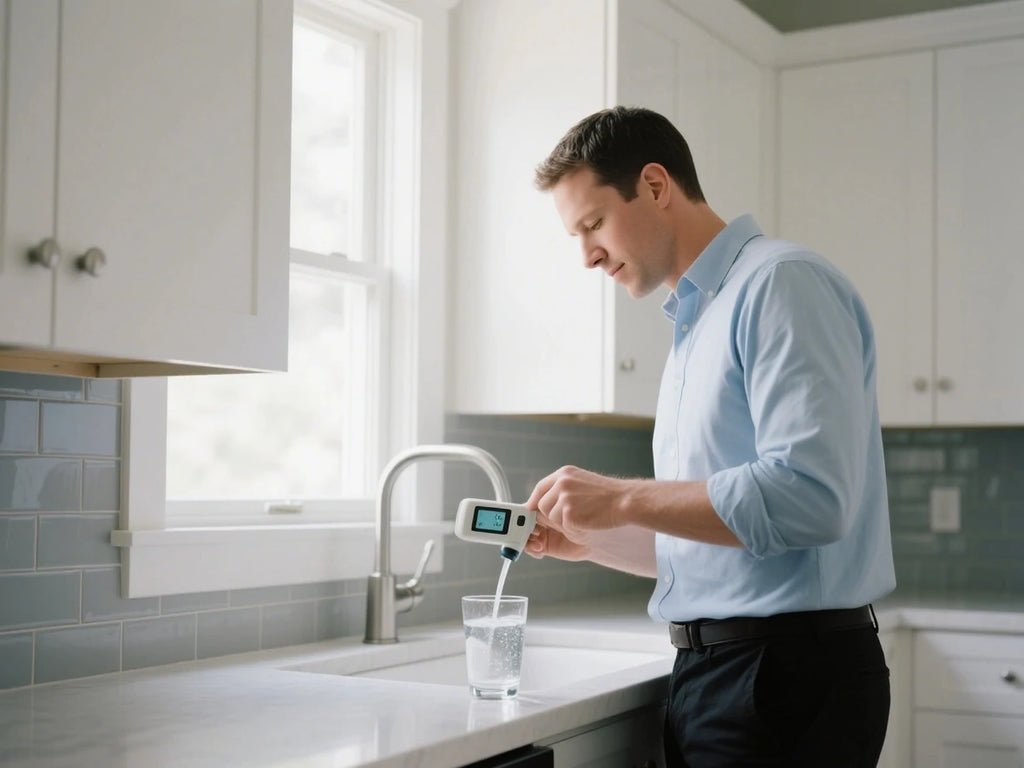
For the most reliable result, start with a laboratory or qualified water test that reports hardness and identifies iron or manganese if present. Hardness can be estimated with some screening kits, but a complete test is more useful when you are choosing treatment equipment for a private well.
How Water Softener Size Is Measured
Most conventional water softeners are sized in grains of hardness removal capacity. A grain is a unit used to describe how much hardness the resin can remove before regeneration is needed.
For example, a softener advertised as a “32,000-grain” model is describing an approximate maximum resin capacity under certain operating conditions. That number does not automatically mean the system should be programmed to use all 32,000 grains between regenerations.
In practice, the important specifications are:
- Measured hardness: Usually reported in grains per gallon (GPG) or milligrams per liter (mg/L).
- Daily water use: Based on household size, water habits, and fixtures.
- Usable capacity: The capacity available at the selected salt dose and regeneration setting.
- Service flow rate: How much softened water the system can provide without excessive pressure loss.
- Iron and manganese content: Dissolved metals can reduce softener performance and may require pretreatment.
- Regeneration frequency: How often the resin needs to be cleaned and recharged with brine.
A properly sized softener should generally provide several days of softened water between regenerations under normal household use. The ideal interval depends on the equipment, water chemistry, household demand, and the manufacturer’s programming guidance.
Start With an Accurate Water Test
The first step in sizing a water softener is confirming your actual hardness level. Water hardness is caused primarily by dissolved calcium and magnesium. These minerals are not usually a health concern, but they can cause scale buildup, reduce soap lather, leave spots on dishes, and shorten the useful life of water-using appliances.
Hardness may be reported in two common units:
- Grains per gallon (GPG)
- Milligrams per liter (mg/L), often expressed as parts per million
To convert hardness from mg/L to GPG, divide the mg/L result by 17.1. For example, water measured at 171 mg/L as calcium carbonate is about 10 GPG.
A water test should also consider iron and manganese, especially for private well owners. A softener can sometimes handle modest amounts of dissolved ferrous iron, but iron-heavy water can foul resin, reduce capacity, and create staining or performance problems. Manganese can be even more difficult to treat with a standard softener.
If your water has orange, reddish-brown, black, or gray staining; sediment; sulfur odor; cloudy water; or elevated iron or manganese, do not assume a basic softener alone is the right treatment. The treatment sequence may need sediment filtration, oxidation and filtration, pH adjustment, or another system ahead of the softener.
Calculate Your Household’s Daily Softening Requirement
Once you know the hardness level, estimate how many hardness grains your home uses each day. The basic calculation is:
Daily hardness load = water hardness (GPG) × daily water use (gallons)
Daily household water use varies widely. A home with efficient fixtures and two occupants may use far less water than a larger family with several bathrooms, frequent laundry, irrigation connected to the softened line, or long showers. For rough planning, many sizing estimates use a per-person daily water-use assumption, but your utility records, flow meter data, or well-system history can provide a more accurate picture.
When using a planning estimate, include the people who regularly live in the home and allow for reasonably expected changes, such as a growing family or frequent overnight guests. Avoid oversizing solely for rare events, but do not size so tightly that one busy weekend triggers repeated regeneration.
Example: Four-Person Household
Assume a household has four people, water hardness of 15 GPG, and estimated water use of 60 gallons per person per day.
- Four people × 60 gallons = 240 gallons per day
- 240 gallons × 15 GPG = 3,600 grains of hardness per day
In this example, the household needs to remove about 3,600 grains of hardness each day. If the owner wants the softener to regenerate roughly once a week, the system would need usable capacity for approximately 25,200 grains, plus an appropriate reserve or demand-based regeneration setting.
This does not mean every four-person household should buy a specific grain size. If hardness is 5 GPG instead of 15 GPG, the daily load is much lower. If the household uses more water, has iron present, or has high peak flow demand, the selection may change.
Example: Two-Person Household With Very Hard Water
Now assume two people use an estimated 60 gallons per person per day, but the water measures 30 GPG.
- Two people × 60 gallons = 120 gallons per day
- 120 gallons × 30 GPG = 3,600 grains per day
Although this home has fewer people, it has the same estimated daily hardness load as the first example because the water is twice as hard. This is why household size alone is not enough to determine what size water softener you need.
Nominal Capacity vs. Usable Capacity
A common sizing mistake is choosing a softener based only on its advertised grain rating. The maximum capacity rating is often tied to a high salt dose per regeneration. Operating a system at its maximum possible capacity may use more salt and water than necessary.
The usable capacity is the amount of hardness removal you can expect at the programmed salt setting. Depending on the resin volume, control valve, salt dose, and manufacturer’s specifications, a unit may deliver different usable capacities at different efficiency settings.
When comparing models, ask for the manufacturer’s capacity and salt-efficiency data at the intended operating settings. A qualified water-treatment professional should be able to explain:
- How much resin the softener contains
- The usable capacity at the recommended salt dose
- Expected salt use per regeneration
- Expected water use per regeneration
- The recommended regeneration interval for your water conditions
- The system’s rated continuous and peak service flow
A smaller system programmed inefficiently can use more salt over time than a properly selected unit with demand-initiated regeneration. Conversely, a very large system serving a low-use household may go too long between regenerations if it is not configured correctly for the equipment and water conditions.

Credit: waterdropfilter.com
Choose a Regeneration Strategy That Matches Your Household
Most modern softeners can regenerate either on a fixed schedule or based on measured water use. A metered, demand-initiated system tracks water consumption and regenerates when the available capacity is nearly used.
Demand-initiated regeneration is often a better fit for households with changing water use because it responds to actual demand rather than regenerating every few days whether the capacity was used or not.
However, the settings still need to be correct. The installer or homeowner must program the hardness level, usable capacity, salt dose, reserve capacity, and other values according to the specific control valve and manufacturer instructions.
Important point: a softener should not be allowed to sit for excessively long periods without regeneration simply because water use is low. Resin condition, water chemistry, control-valve design, and manufacturer recommendations matter. Follow the system manual rather than applying a universal regeneration schedule.
Do Not Ignore Peak Flow Rate
Capacity determines how many grains of hardness the softener can remove before regeneration. Flow rate determines whether it can supply enough softened water when several fixtures run at once.
A softener that has enough grain capacity but insufficient service flow may create a noticeable pressure drop during high demand. This can happen when people shower while a washing machine fills, a dishwasher runs, or multiple bathrooms are used at the same time.
When comparing systems, review the manufacturer’s rated service flow rate and pressure-drop information. Consider:
- Number of bathrooms
- Number of regular occupants
- Fixture types and shower flow rates
- Large soaking tubs or multi-head showers
- Water use during laundry and dishwashing
- Whether outdoor spigots or irrigation are connected to softened water
- Your existing well pump and pressure system capacity
Flow rate is particularly important in homes with well systems that already have marginal pressure or limited pump output. A softener cannot create water pressure, and an undersized or restricted treatment system can add pressure loss. If the whole house already experiences low pressure, evaluate the well pump, pressure tank, pressure switch or controller, plumbing restrictions, and filters before assuming the softener is the only issue.
How Iron and Manganese Affect Softener Sizing
Hardness is not the only mineral consideration in well water. Dissolved iron and manganese can affect both softener selection and maintenance requirements.
Some water softeners are designed to remove limited amounts of dissolved iron along with hardness. But a conventional softener is not always the best primary iron filter. Iron can coat resin beads, reduce exchange capacity, interfere with regeneration, and cause staining even when the water feels softer.
The type of iron matters as well. Clear-water ferrous iron behaves differently from oxidized iron particles, iron bacteria, or iron associated with sediment. Water that turns orange after standing may contain dissolved iron that oxidizes when exposed to air, while visible particles may require filtration rather than relying on a softener.
If iron or manganese is present, ask the treatment provider whether the quoted softener capacity has been adjusted appropriately and whether pretreatment is recommended. Do not use a generic “iron compensation” formula without confirming that it applies to your equipment and water chemistry.

Credit: waterdropfilter.com
Select the Right Resin Tank and Brine Tank Configuration
A complete softener usually includes a mineral tank filled with ion-exchange resin, a control valve, and a brine tank that holds salt and water for regeneration. The resin tank size and resin quantity affect both capacity and flow performance.
Larger resin volume can provide more usable capacity and, depending on the system design, support higher flow. But tank size must also fit your installation space and available plumbing layout.
Before purchasing, measure:
- Width, depth, and height of the installation area
- Doorways, stairs, utility-room access, and clearances
- Location of the main water line
- Available electrical outlet, if required by the control valve
- Drain access approved for regeneration discharge
- Space to add salt and perform maintenance
Regeneration discharge needs a suitable drain connection with proper air-gap protection where required by local plumbing rules. Do not route discharge based on convenience alone. Check local requirements and the softener manufacturer’s installation instructions.
Whole-House Softening vs. Softening Only Selected Lines
Most homes install a water softener at the point where water enters the home, treating the plumbing system as a whole. This protects water heaters, fixtures, dishwashers, and washing machines from hardness scale.
However, some lines are often left unsoftened, depending on the home’s plumbing and local preferences. These may include outdoor hose bibs, irrigation systems, or other high-volume uses where softened water is unnecessary.
Keeping irrigation and outdoor taps off the softener can reduce water demand, salt use, and regeneration frequency. It also avoids applying softened water to landscaping where sodium addition may be undesirable for certain soils or plants.
If you plan to soften only part of the home, size the unit based on the water that will actually pass through it. A whole-house calculation will overestimate capacity if outdoor use is bypassed.
Common Water Softener Sizing Mistakes
Choosing by household size alone
A “three-bedroom home” or “family of four” recommendation is only a starting point. Hardness level and actual water use can make two similar households require very different capacities.
Buying based only on maximum grain rating
Compare usable capacity, salt efficiency, and service flow—not just the largest number on the product label.
Ignoring iron, manganese, pH, or sediment
A softener works best when the water chemistry is understood. Pretreatment may be necessary to protect the resin and achieve consistent results.
Assuming soft water means safe drinking water
Softening reduces calcium and magnesium through ion exchange. It does not disinfect water or remove every possible contaminant. It is not a substitute for testing for local well-water risks such as bacteria, nitrate, arsenic, lead, or other contaminants relevant to your area.
Sending every gallon through the system
Outdoor watering, irrigation, and other high-volume non-household uses can consume softener capacity quickly. A bypassed outdoor line may be more practical when plumbing allows.
Forgetting ongoing maintenance
A softener needs the correct salt, periodic inspection, and maintenance appropriate to the valve and water conditions. Salt bridges, salt mushing, resin fouling, blocked injectors, and drain-line problems can all reduce performance.
Questions to Ask Before Buying a Water Softener
Before selecting a system, gather the information needed to compare options on more than marketing claims:
- What is the tested hardness in GPG or mg/L?
- Are iron, manganese, sediment, sulfur, low pH, or bacteria concerns present?
- How many people normally use water in the home?
- What is your estimated indoor daily water use?
- What fixtures may run at the same time?
- What service flow rate does the softener provide at an acceptable pressure drop?
- What is the usable capacity at the recommended salt setting?
- How much salt and regeneration water does the system use under expected conditions?
- Does the home have an appropriate drain and enough installation space?
- Which plumbing lines will be softened and which will bypass the system?
For a private well, keep a copy of the full water test with your well and treatment records. It gives installers and service technicians a clearer basis for recommendations than a hardness estimate alone.

Credit: abchomeandcommercial.com
Frequently Asked Questions
Is a larger water softener always better?
No. A larger unit may offer more capacity and flow potential, but it can cost more and may be inefficient for a small, low-use household if it is not configured properly. Choose capacity and flow based on measured hardness, expected demand, and the manufacturer’s operating guidance.
Can I use a water softener if my well water has a rotten-egg smell?
A rotten-egg odor may be related to hydrogen sulfide, sulfur bacteria, a water heater issue, or other conditions. A standard softener is not a reliable sulfur-treatment system. Identify the cause through testing and observation, including whether the odor occurs in hot water, cold water, or both, before choosing treatment.
How often should a properly sized softener regenerate?
There is no single correct schedule. A demand-initiated softener should regenerate based on actual water use and programmed usable capacity, while still following any maximum interval specified by the manufacturer. Frequent regeneration can indicate undersizing, high water use, incorrect settings, or a mechanical problem.
Will a water softener lower my water pressure?
Any treatment system can create some pressure loss as water flows through it. A correctly selected softener with adequate service flow should minimize noticeable loss under normal demand. Significant pressure problems may also involve clogged filters, plumbing restrictions, a weak well pump, or pressure-system issues.
Should I test my water again after installing a softener?
Yes. Post-installation testing can help confirm that the system is reducing hardness as expected and can identify whether other untreated water concerns remain. Use the appropriate test for the question being asked; hardness testing does not confirm the absence of bacteria, nitrate, arsenic, or other contaminants.