
A whole house carbon water filter treats water as it enters the home, so filtered water reaches showers, faucets, appliances, and other plumbing fixtures. Its main job is usually to reduce chlorine, unpleasant tastes and odors, and certain organic chemicals that activated carbon can adsorb.
For private well owners, carbon filtration can be useful, but it is not a universal well-water solution. A rotten-egg odor, staining, bacteria concern, sediment problem, or dissolved mineral issue may require different treatment or pretreatment before carbon can work properly.
The right system depends on what is actually in the water, how much water the household uses at peak demand, and whether the filter is intended for municipal water, well water, or both. This guide explains how whole-house carbon filtration works, where it fits, and how to choose and maintain it responsibly.
What a Whole-House Carbon Filter Does
A whole house carbon water filter uses activated carbon media to capture or adsorb certain substances as water passes through the tank or cartridge. Activated carbon has a highly porous surface, creating many places where particular dissolved compounds can attach.
Carbon filtration is especially common for improving water’s aesthetic qualities. Depending on the carbon media, system design, water chemistry, and contact time, it may help reduce:
- Chlorine taste and odor
- Some chloramine-related taste or odor concerns
- Many volatile organic compounds (VOCs)
- Some pesticide or industrial chemical compounds, when the specific filter is designed and certified for those claims
- Musty, chemical, or earthy tastes and odors
- Some compounds associated with naturally occurring organic matter
For homes supplied by a public water system, chlorine or chloramine reduction is often the primary reason to install carbon filtration. For private wells, the reason may be a specific odor or taste issue, but testing and diagnosis matter more because well-water problems have many possible causes.
How Activated Carbon Filtration Works
Activated carbon is made from carbon-rich materials that have been processed to create an extensive internal pore structure. The water flows through or across the media, and certain compounds are attracted to and held on the carbon surface. This process is called adsorption, which differs from absorption.
Performance depends on more than the presence of carbon. A system needs adequate media volume, appropriate water flow, enough contact time, and suitable source-water conditions. Water moving too quickly through a small filter may have limited contact with the media, even if the filter contains quality carbon.
Granular activated carbon
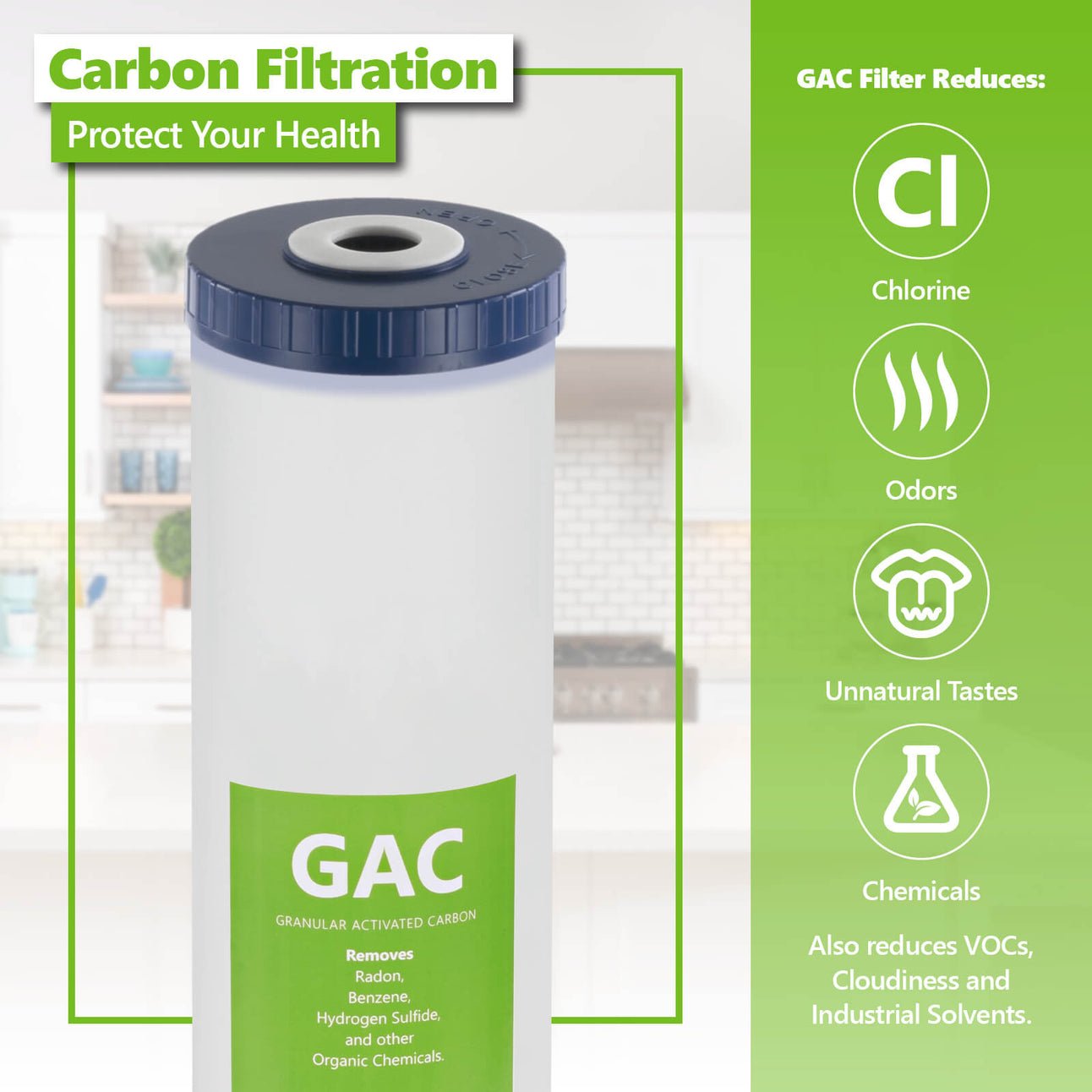
Granular activated carbon, often called GAC, consists of loose carbon granules inside a tank or cartridge. In whole-house systems, GAC is commonly installed in a larger media tank that can support household flow better than a small under-sink filter.
Tank-based GAC filters may need periodic backwashing. Backwashing reverses water flow through the tank to loosen compacted media, flush accumulated particles, and help maintain flow. Not every carbon system backwashes, so homeowners should follow the design and manufacturer’s service instructions.
Carbon block filters
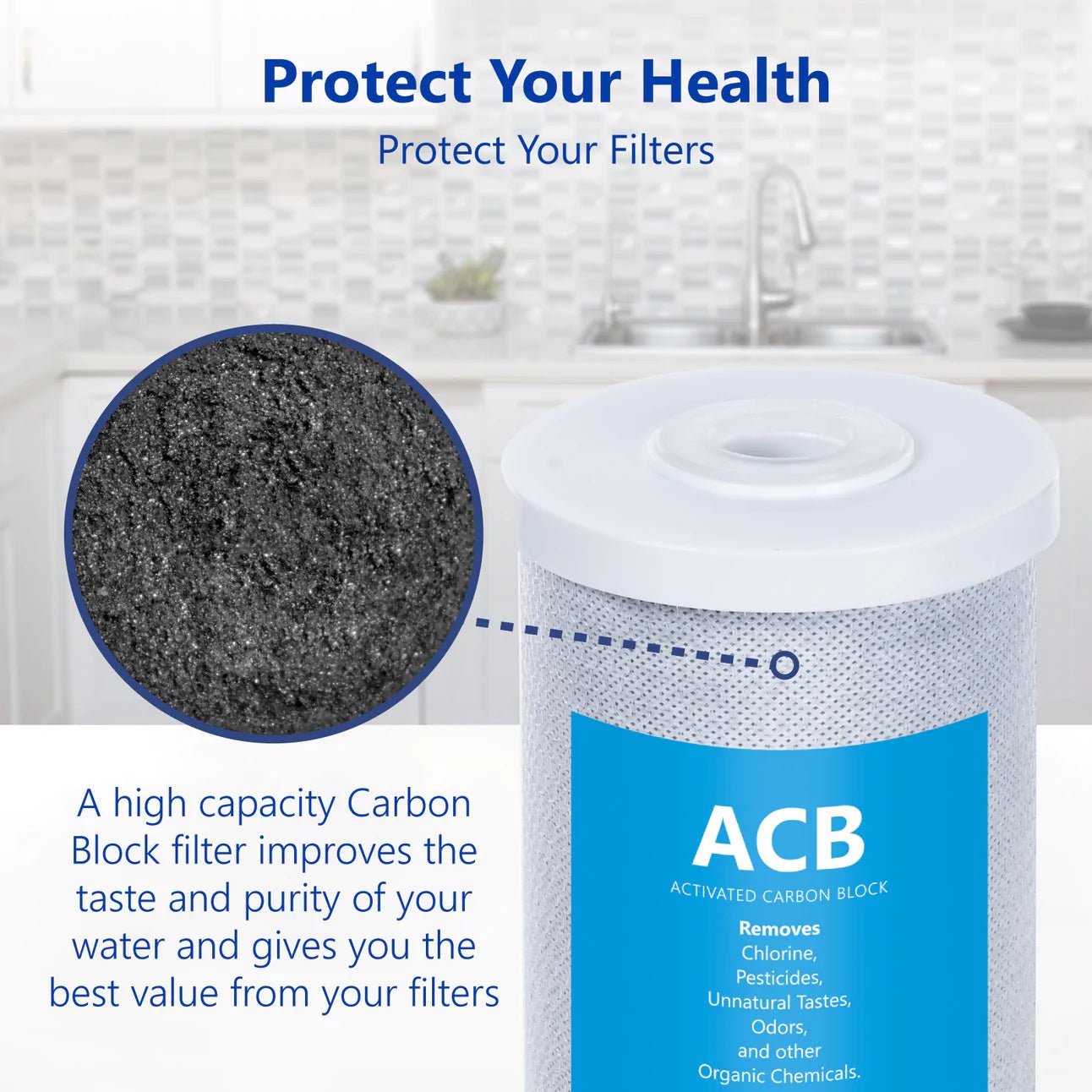
Carbon block filters compress carbon into a dense block. They can offer fine filtration along with carbon treatment, depending on the model. However, the dense structure can create more pressure loss than a large media tank, especially as the cartridge loads with sediment.
Carbon block cartridges are often used at the point of use, such as under a kitchen sink, but some whole-house cartridge housings use them as well. A whole-house carbon block system should be sized carefully for the household’s expected flow rate and plumbing needs.
Catalytic carbon
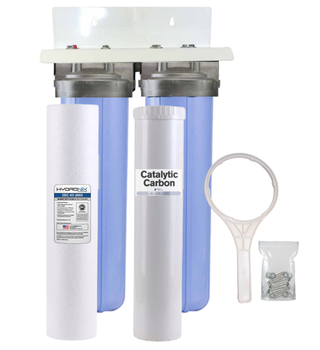
Catalytic carbon is a modified activated carbon media designed to improve performance for certain difficult-to-treat compounds. It is often considered for chloramine reduction and can be used in some odor-treatment applications.
It is not automatically the best choice for every home. The source-water chemistry, flow rate, contact time, and the exact contaminant all affect whether catalytic carbon is appropriate. For example, a sulfur odor caused by hydrogen sulfide may need oxidation and filtration rather than carbon alone.
What Carbon Filters Do Not Reliably Remove
A carbon filter should not be treated as proof that water is safe to drink. It can improve taste and reduce selected contaminants, but it does not remove every substance that may be present in well water or municipal water.
| Water concern | Can carbon help? | Important limitation |
|---|---|---|
| Chlorine taste and odor | Often, yes | Performance depends on flow, media condition, and system design. |
| Chloramine | Sometimes | Usually requires media and contact time specifically suited to chloramine reduction. |
| Sediment | Limited | A dedicated sediment filter is usually needed to protect carbon media. |
| Hardness minerals | No | Carbon does not soften water or remove calcium and magnesium hardness. |
| Iron and manganese | Usually not as a primary treatment | These minerals can foul carbon and often need oxidation and specialized filtration. |
| Bacteria, viruses, or parasites | No reliable disinfection | Carbon does not replace properly designed disinfection, such as UV used with suitable pretreatment. |
| Nitrate, arsenic, or many dissolved salts | Not reliably | These require treatment selected for the tested contaminant. |
Some products make specific contaminant-reduction claims, but those claims are model-specific. Look for documentation showing what the exact system has been tested or certified to reduce, under what conditions, and at what service interval. A carbon filter carrying a general certification mark does not mean it reduces every contaminant covered by that certification category.
When Carbon Filtration Makes Sense for Well Water
Whole-house carbon filtration is most useful for well water after the homeowner understands the source of the problem. Water from a private well is not disinfected or monitored by a public utility, and its quality can change with rainfall, flooding, nearby land use, plumbing changes, or well repairs.
Carbon may be a reasonable part of the treatment train when testing and system evaluation indicate a need for odor or organic-compound reduction. It may also be used after another treatment stage to polish water before it reaches household plumbing.
Credit: expresswater.com
Chlorine remaining after well disinfection
Some well owners use a temporary disinfection process after a confirmed bacterial issue or well repair. If chlorine remains in the water after the applicable procedure has been completed, carbon can help reduce chlorine taste and odor. However, carbon should not be installed in a way that prevents an intentional, properly managed disinfection residual from reaching the part of the system where it is needed.
When a well has tested positive for bacteria or another health-related contaminant, use a known safe water source as directed by local health authorities. Do not assume that a carbon filter resolves the underlying contamination problem.
Odors that need further diagnosis
A sulfur or rotten-egg smell can come from hydrogen sulfide in the groundwater, sulfur bacteria, a water heater reaction, or plumbing conditions. The pattern helps narrow the possibilities:
- An odor in both hot and cold water may point to the well water or a treatment-system issue.
- An odor only in hot water may indicate a water-heater-related cause.
- An odor at one faucet may be related to that fixture or drain rather than the water supply.
Carbon can sometimes reduce an odor, but high hydrogen sulfide levels or sulfur bacteria can exhaust or foul carbon quickly. Oxidation, aeration, specialized media, disinfection, or other treatment may be needed before or instead of carbon.
Organic chemical concerns
If there is a known or suspected source of chemical contamination near a well, do not choose a filter based only on odor or taste. Contact the local health department or a qualified laboratory about appropriate testing. For suspected harmful chemical contamination, do not assume that boiling water, adding carbon, or using the water for bathing is safe.
Testing identifies the analytes present in the submitted sample; it does not establish that untested contaminants are absent. Treatment should be selected based on the laboratory result, its units, the reporting basis, and the specific reduction capability of the equipment being considered.
Whole-House Carbon Filter vs. Other Treatment Options
Carbon filtration is one tool in a larger home water-treatment system. Choosing the right tool starts with matching the technology to the actual problem.
| Treatment type | Primary purpose | Where it may fit with carbon |
|---|---|---|
| Sediment filter | Captures sand, silt, rust particles, and other suspended material | Often installed before carbon to prevent clogging and media fouling. |
| Water softener | Removes hardness minerals through ion exchange | May be used separately when hardness is confirmed; carbon does not replace it. |
| Iron or sulfur treatment | Addresses iron, manganese, and hydrogen sulfide using treatment matched to water chemistry | May be installed before carbon when these issues would overload carbon media. |
| UV disinfection | Inactivates microorganisms under appropriate operating conditions | Usually needs clear, prefiltered water; UV does not remove chemicals or sediment. |
| Reverse osmosis | Reduces selected dissolved contaminants at a point of use | Often used at a drinking-water tap, not as a replacement for whole-house carbon. |
A common mistake is buying a carbon filter to solve hardness, orange staining, cloudy water, or confirmed bacteria. Carbon may have a supporting role in some systems, but it is rarely the primary answer to all of those problems.
How to Choose the Right System Size
Whole-house filter sizing is primarily about flow rate, pressure loss, and the amount of carbon media available for treatment. It is not enough to select a system because its tank looks large or because it has a high advertised maximum flow.
Credit: expresswater.com
Start with peak household demand
Peak demand occurs when several fixtures or appliances operate at the same time. A shower, washing machine, dishwasher, and kitchen faucet can create a very different demand than one bathroom faucet alone.
Ask the supplier or installer how the system performs at the household’s expected peak gallons per minute (GPM), not merely its unrestricted or short-duration flow rating. The useful question is whether the system can maintain acceptable pressure and treatment contact time during normal busy periods.
Consider contact time, not only GPM
Carbon needs contact time to adsorb contaminants effectively. A high-flow system with very little media may maintain pressure but provide limited treatment, while an oversized media tank can offer better contact time but may be unnecessary for a small household.
For municipal water, chlorine reduction may be relatively straightforward when the system is designed for the home’s demand. Chloramine reduction and certain well-water odor applications may require more contact time and more careful design.
Check pressure loss and plumbing compatibility
Every filter creates some resistance to water flow. Pressure loss tends to increase as cartridges load with sediment or as carbon media becomes fouled. Review:
- The home’s incoming pressure and normal pressure range
- Expected flow through the filter
- Pipe size and connection size
- Pressure loss at the relevant flow rate
- Whether the system needs a bypass for maintenance
- Whether a backwashing unit needs a drain connection and sufficient flow for backwash
For homes with well pumps and pressure tanks, low pressure can also be caused by pump, pressure-switch, tank, plumbing, or restriction issues. Do not assume that adding a larger filter will fix a pressure problem.
Cartridge Systems and Media Tanks
Whole-house carbon filters are commonly sold in two formats: replaceable cartridge systems and larger media tanks. Each can be appropriate, but they serve different needs.
Replaceable carbon cartridges
Cartridge filters are generally compact and straightforward to understand. They can be suitable for smaller households, targeted treatment, or homes where space and installation simplicity matter.
The trade-off is that cartridges may require more frequent replacement, especially when water contains sediment. They can also create noticeable flow restriction if undersized or left in service too long.
Backwashing carbon media tanks
A media tank contains a larger volume of carbon and may be better suited to whole-house flow and longer service intervals. Systems designed to backwash can help prevent channeling and remove trapped sediment.
These units need adequate installation space, a suitable drain arrangement, and controller settings matched to the media and water conditions. Backwashing is not a substitute for source-water testing or for pretreatment when iron, sediment, or biological fouling is significant.
Installation Considerations
A whole-house carbon filter is usually installed on the main water line after the pressure tank for a private well, or after the water meter or main shutoff arrangement for a municipal supply. The exact sequence depends on the equipment and the water problem being treated.
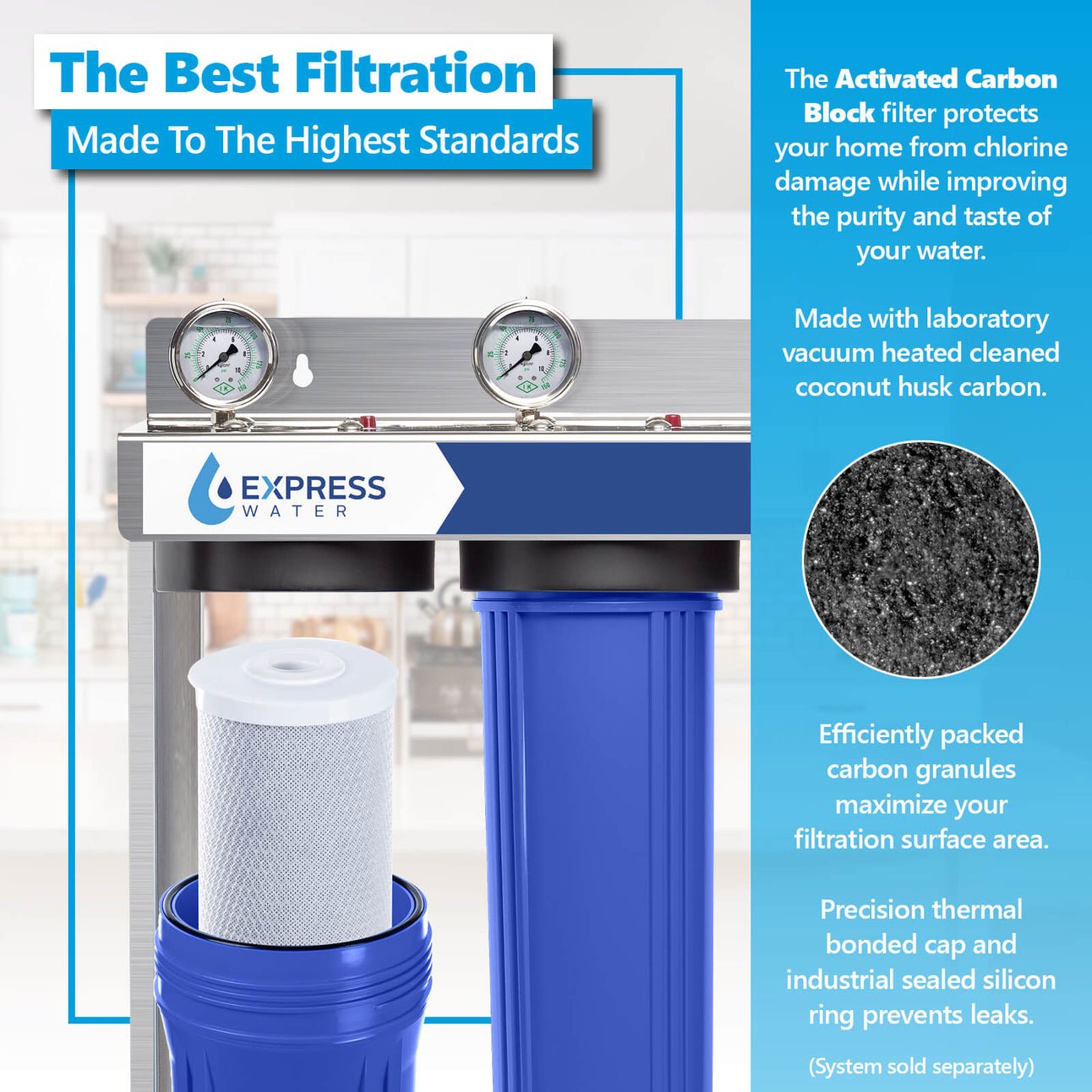
In many systems, a sediment prefilter goes before carbon. This protects the carbon from particles that can clog its pores or restrict flow. Other treatment equipment may need to come before or after carbon depending on its purpose. For example, treatment intended to oxidize iron or hydrogen sulfide follows a different sequence than a simple chlorine-taste filter.
A professional installer can be particularly helpful when the project involves a pressure tank, electrical controls, a drain line, chemical feed equipment, UV equipment, or changes to the home’s main plumbing. Installation should also include accessible shutoff valves and a bypass, so the filter can be serviced without leaving the house without water.
Maintenance That Protects Performance
Carbon media does not last forever. Once its adsorption sites are used, it may no longer reduce the compounds it was installed to address. Unlike some filter media, activated carbon is not normally restored simply by rinsing it.
Maintenance requirements vary widely by system, water quality, and usage. Follow the manufacturer’s instructions for the exact model, and watch for practical signs that service may be due:
- Chlorine, chemical, or odor concerns return
- Water pressure drops noticeably during high use
- A cartridge becomes visibly loaded with sediment
- A backwashing system stops cycling as intended
- The system reaches its stated service interval or capacity limit
If a carbon filter is used on untreated well water, bacterial growth and fouling can be concerns in some conditions. Keep the system maintained, replace media or cartridges on schedule, and address the source of contamination rather than relying on a neglected filter.
Before opening a filter housing or servicing a tank, shut off water according to the equipment instructions and relieve pressure safely. Do not work on live electrical controls, bypass safety devices, or alter backwash settings without understanding the equipment requirements.
Testing Before and After Installation
Testing is most valuable before buying a system. For a private well, a laboratory test can identify relevant concerns such as coliform bacteria, E. coli, nitrate, pH, hardness, iron, manganese, and other locally relevant contaminants. A local health department, extension office, or certified laboratory can help determine which tests fit the situation.
A TDS meter or basic screening kit can be useful for limited observations, but it does not identify individual contaminants or establish drinking-water safety. Clear water with no odor can still contain contaminants that require laboratory analysis.
After installing treatment for a known issue, follow-up testing can help confirm whether the treatment approach is performing for the contaminant of concern. Use the laboratory’s instructions for sample bottles, preservation, timing, and delivery. A test result applies only to the sample, analytes, methods, and detection limits involved.
Credit: store.afwfilters.com
Frequently Asked Questions
Will a whole-house carbon filter make well water safe to drink?
Not necessarily. Carbon can reduce certain taste, odor, chlorine, and organic-compound concerns, but it is not a complete treatment solution for bacteria, nitrate, arsenic, dissolved salts, or every chemical contaminant. Use laboratory testing to identify health-related concerns and select treatment specifically for the result.
Does activated carbon remove the rotten-egg smell from water?
It may reduce some odors, but results depend on the cause and concentration. Hydrogen sulfide, sulfur bacteria, water-heater conditions, and plumbing issues can all create sulfur-like odors. Determine whether the odor occurs in hot water, cold water, or both before selecting treatment.
How often should whole-house carbon media be replaced?
There is no universal replacement schedule. Media life depends on water use, chlorine or chloramine exposure, sediment load, organic compounds, and the amount of carbon in the system. Follow the model’s maintenance guidance and replace media when its rated service life is reached or treatment performance declines.
Can a carbon filter be installed before a water softener?
Sometimes, but the best order depends on the water chemistry and equipment. Sediment protection is often placed ahead of both systems. If the carbon filter is intended to remove chlorine from municipal water, placing it before a softener may help protect softener resin, but the correct sequence should match the manufacturer’s requirements and the home’s treatment goals.
Why did water pressure drop after installing a carbon filter?
The filter may be undersized for household flow, a cartridge may be clogged with sediment, the carbon bed may be fouled, or another plumbing restriction may be present. Check whether the pressure drop affects the entire home and compare pressure before and after the filter. If the system uses a well pump or pressure tank, rule out broader pressure-system problems before changing filter equipment.