
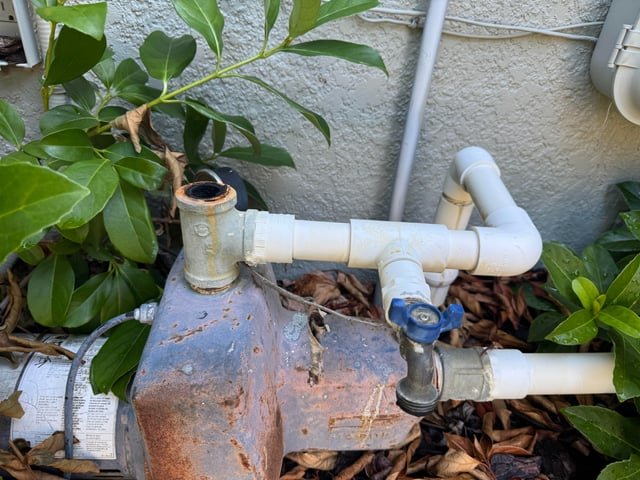
When a well water pump runs but no water pressure reaches the house, the problem is usually somewhere between the water source, pump, pressure tank, controls, and plumbing. The sound of a running pump only confirms that the motor or controller is attempting to move water; it does not prove that water is reaching the pressure tank or building plumbing.
Start by protecting the pump. If it runs continuously without building pressure, avoid letting it run indefinitely. A pump that cannot move water can overheat, and repeated cycling or resetting can turn a smaller repair into a pump or control failure.
The most useful first clues are the pressure gauge reading, whether the issue affects every fixture, and whether anything recently changed—such as a power outage, plumbing repair, drought, flooding, filter replacement, or unusually high water use.
What the Symptom Usually Means
A typical private well pressure system works in a sequence: the pump moves water from the well, the pressure tank stores a small usable amount of pressurized water, and a pressure switch or electronic controller starts and stops the pump as demand changes.
If the pump is operating but pressure stays low or falls to zero, one of three broad conditions is likely:
- The pump is not receiving water from the well.
- The pump is moving water, but water is escaping or being restricted before it reaches the house.
- The pump, controls, pressure tank, or plumbing system is not operating as expected.
The pressure gauge helps narrow the possibilities. A gauge that remains near zero while the pump runs points to a serious loss of water supply, a major leak, a failed pump component, or a bad gauge. A gauge that rises but never reaches normal shutoff pressure may indicate restricted flow, a leak, a worn pump, low well yield, or an incorrect control setting.
Safety Steps Before Troubleshooting
Private well systems combine water pressure and electrical equipment. Do not remove electrical covers, touch wiring, bypass controls, repeatedly reset a tripped breaker, or work on a pump circuit while energized. Deep-well submersible pumps are especially hazardous to service because the pump, wiring, pipe, and safety rope may be hundreds of feet below ground.
If you suspect contamination after flooding, a well repair, a damaged well cap, or a sudden change in water quality, use a known safe water source for drinking and food preparation until appropriate testing is complete. Restoring pressure does not establish that the water is safe.
For a pump that has run continuously without producing pressure, turn off power at the appropriate disconnect or breaker only if you can do so safely and identify the circuit confidently. Then contact a qualified well contractor if the simple checks below do not identify an obvious plumbing issue.
Quick Checks That Can Narrow Down the Cause
Before assuming the pump has failed, gather a few observations. These checks can save time and give a well professional useful information.
Check whether all fixtures are affected
Open a cold-water tap at more than one location. If only one sink, shower, toilet, or appliance has poor pressure, the issue may be a blocked aerator, a closed fixture stop valve, a cartridge problem, or a local plumbing restriction. A well pump problem normally affects the entire home.
If both hot and cold water are weak everywhere, focus on the main water supply, treatment equipment, pressure tank, and pump system. If cold water is normal but hot water is weak, the well pump is less likely to be the cause; the water heater or hot-water plumbing may need attention.
Read the pressure gauge
Most conventional systems have a gauge near the pressure tank. Note its position while no water is being used and while a faucet is open. Do not rely on one observation if the needle is visibly stuck, cracked, fogged, or erratic.
| Gauge behavior | What it may suggest | Useful next step |
|---|---|---|
| Near zero while the pump runs | No water entering the pressure system, a major leak, pump trouble, low well water level, or an inaccurate gauge | Stop prolonged pump operation and arrange diagnosis if no visible plumbing leak is found |
| Rises slowly but does not reach shutoff pressure | Restricted flow, worn pump, leak, low yield, or control issue | Check filters and visible valves; record the highest pressure reached |
| Pressure is normal at the tank but poor at fixtures | Restriction after the tank, treatment equipment issue, closed valve, or plumbing problem | Inspect accessible filters, bypasses, and main valves |
| Needle does not move despite changing water use | Gauge may be faulty or clogged at its connection | Have the gauge and pressure sensing connection evaluated |
Look for obvious leaks or open drains
Walk through accessible areas, including the pressure tank location, basement, crawlspace, utility room, hose connections, and outdoor hydrants. Listen for water movement where there should be none. Check for a toilet that is constantly refilling, a broken pipe, a leaking water-treatment backwash valve, or an open drain valve.
A large leak downstream of the pressure tank can prevent pressure from building. A leak in the buried line between a well and house can do the same, but it may not be visible. Wet soil, unexplained puddles, unusually lush patches of grass, or a sudden increase in pump run time can be clues, not proof.
Confirm accessible valves are open
A partially closed main shutoff valve, a closed valve after a filter, or an incorrectly positioned treatment-system bypass can restrict or stop water flow. Check only valves you can identify safely and understand. Do not force corroded valves or turn unfamiliar valves at the wellhead.
If work was recently done on a sediment filter, softener, iron filter, or reverse osmosis system, review what was changed. A blocked cartridge, a valve left in bypass or service incorrectly, or a treatment unit stuck during a regeneration or backwash cycle may affect household flow.
Most Common Causes of a Running Pump With No Pressure
Credit: plumbinglab.com
The well water level is too low or well yield cannot meet demand
A well can temporarily produce less water than the household is using. Dry weather, seasonal groundwater changes, a drought, heavy irrigation, filling a pool, or simultaneous high-demand use can lower the pumping water level below the pump intake. The pump may continue to run, but it may pull little or no water.
This is different from the total depth of the well. A well may be deep while its usable water level drops during pumping. Only a proper well evaluation can determine pumping water level and yield.
Turn off or reduce high-demand uses and allow time for the well to recover. If pressure returns after rest but disappears again during use, report that pattern to a qualified well contractor. Possible long-term solutions depend on the well’s measured yield, pump placement, household demand, and storage options; installing a larger pump is not automatically the answer.
A jet pump has lost its prime
Above-ground jet pumps depend on water inside the pump and suction piping to create the suction needed to lift water. If air enters the line, a foot valve leaks, the well level drops too far, or the pump is drained during service, the pump can run without moving water.
Loss of prime applies to jet-pump systems, not typical deep-well submersible pumps. Do not use jet-pump priming instructions on a submersible system.
Many jet pumps have model-specific priming procedures. Follow the pump manufacturer’s manual or use a well professional, particularly if the system repeatedly loses prime. Repeated loss of prime often means a leaking foot valve, suction-line leak, or another condition that needs repair rather than repeated refilling.
A submersible pump or its internal components are worn or damaged
A submersible pump can make the system appear active while producing too little water. Depending on the system, the motor may run but the pump stages may be worn, clogged by sediment, damaged, or unable to overcome the required lift and pressure. A split drop pipe, failed check valve, or damaged fitting in the well can also allow pumped water to flow back into the well instead of toward the house.
These faults generally require professional diagnosis because confirming them may involve electrical testing, flow testing, pressure observations, or pulling the pump. Avoid assuming that a running motor means the entire pump assembly is working correctly.
A pressure tank problem is causing rapid cycling or misleading symptoms
A conventional pressure tank does not create water pressure on its own; it stores pressurized water and reduces how often the pump must start. If its air charge is incorrect, the bladder or diaphragm has failed, or the tank has become waterlogged, the pump may cycle rapidly and pressure may swing sharply.
However, a failed pressure tank usually does not fully explain a gauge that stays at zero while the pump runs. It can worsen performance and shorten pump life, but no pressure at all more often points to a supply, leak, pump, or control problem.
Tank precharge checks must be done with power isolated and all water-side pressure fully relieved, following the exact tank manufacturer’s instructions. Because pressure tanks can be dangerous when damaged or improperly pressurized, leave uncertain tank service to a qualified professional.
A pressure switch or electronic controller is malfunctioning
Mechanical pressure switches and constant-pressure controllers determine when the pump should run. A switch with worn contacts, a clogged pressure-sensing port, or an incorrect reading can keep the pump running too long or fail to respond accurately to pressure changes. Electronic controllers can also limit or interrupt pump operation when they detect dry-run conditions or faults.
Since these components involve live electrical connections, a homeowner should not attempt internal repairs. A technician can verify actual system pressure, test the controls, and determine whether the issue is the control itself or a response to another problem.
A blocked filter or treatment unit is restricting flow
A severely loaded sediment filter can create dramatic pressure loss, especially when the home uses fine cartridges or the well suddenly produces more sand, silt, or rust particles. Iron filters, softeners, and other whole-house equipment can also restrict flow if media is fouled, control valves malfunction, or the unit is undersized for household flow demand.
If pressure is normal before a treatment system but weak after it, the restriction is likely downstream of the pressure tank. Replace filters only according to the housing and filter manufacturer’s instructions, with water supply isolated as required. A recurring clogged filter deserves investigation because it may signal sediment entering from the well, deteriorating plumbing, or an unsuitable filter setup.
A Practical Diagnostic Sequence
Use this order to separate simple plumbing issues from faults that require well service.
- Stop unnecessary water use. Turn off irrigation, appliances, and other large demands while diagnosing the issue.
- Determine the scope. Check whether the problem affects the whole house or only one fixture, and whether hot and cold water behave differently.
- Observe the pressure gauge. Record the pressure at rest, with a faucet open, and while the pump is running. Note whether the gauge changes at all.
- Inspect accessible plumbing. Look for leaks, open drains, running toilets, and obvious water around equipment or in the yard.
- Check accessible valves and filters. Verify known shutoff valves are fully open and inspect recently serviced filtration or treatment equipment.
- Consider recent events. Note power outages, well repairs, drought, flooding, water-quality changes, landscaping work, or unusually high water use.
- Call a qualified well contractor when pressure will not build. Share your observations rather than guessing at a failed component.
A contractor may evaluate pump amperage, system pressure, flow rate, well recovery, check valves, drop pipe, controls, and pump performance. These measurements are needed to distinguish a worn pump from a low-yield well, underground leak, or pressure-system restriction.

Credit: scwellservice.com
What Not to Do
- Do not allow a pump to run for long periods when it is clearly not building pressure.
- Do not repeatedly cycle a breaker or reset a protection device that trips.
- Do not adjust pressure-switch settings to compensate for an unknown loss of water.
- Do not assume a larger horsepower pump will solve low yield, a leak, or a restriction.
- Do not pull a deep-well pump without the proper equipment and experience.
- Do not treat a return of pressure as proof that water quality is safe after flooding or a well breach.
Repairs That May Be Needed
The right repair depends on the confirmed cause. Minor repairs can include replacing a clogged filter cartridge, correcting a valve position, repairing an accessible plumbing leak, or servicing a jet-pump priming issue. More involved work may include repairing buried piping, replacing a foot valve or check valve, servicing a pressure tank, repairing controls, cleaning or replacing a pump, or addressing limited well yield.
For pump replacement, a contractor should consider more than the old pump’s horsepower. Proper selection depends on the pumping water level, well yield, required household flow, desired pressure, pipe size, elevation changes, total dynamic head, and the pump curve. A pump that is too large can overdraw a low-yield well or cause excessive cycling; one that is too small may not provide the needed pressure and flow.
If the well has a yield limitation, the remedy may involve demand management, a storage tank with suitable controls, water-use changes, or well rehabilitation where appropriate. The best option is based on measured conditions, not the symptom alone.
How to Prevent Future No-Pressure Problems
Not every failure is preventable, but routine attention can catch warning signs early and reduce stress on the system.
- Pay attention to longer pump run times, new pressure swings, sputtering faucets, or repeated loss of pressure.
- Replace sediment filters on a schedule based on actual loading and pressure loss, not appearance alone.
- Keep the well cap secure and the area around the well protected from damage, flooding, and surface runoff.
- Repair dripping fixtures, running toilets, and outdoor leaks that make the pump run unnecessarily.
- Avoid running several major water demands at once if the well has limited yield.
- Keep records of pump work, pressure settings, filter changes, water tests, and any periods of low production.
- Arrange professional evaluation when the system begins short cycling or cannot maintain its usual pressure.
Homeowners with older systems may also benefit from having a well professional document the pump type, approximate installation depth, pressure tank model, pressure-control settings, and treatment equipment sequence. That information makes future troubleshooting faster and helps prevent incompatible replacement parts or settings.

Credit: berksplumbingspecialist.net
Frequently Asked Questions
Can air in my water lines cause the pump to run without pressure?
Air can cause sputtering faucets and, in a jet-pump system, contribute to loss of prime. But air in household plumbing alone usually does not cause a pump to run continuously with zero pressure. Persistent air may indicate a water-level issue, a suction-side leak on a jet pump, or another system problem that should be evaluated.
Why does water pressure return after I turn the pump off for a while?
Temporary recovery can occur when the well water level has time to rise after heavy demand. It can also happen when an overheating pump or control cools down. Because those causes require different repairs, note how long recovery takes and what water use occurred before the pressure loss.
Could a whole-house water filter make it seem like the well pump failed?
Yes. A heavily clogged filter can sharply reduce flow after the pressure tank, making fixtures seem to have no pressure even when the pump and tank are functioning. Compare pressure before and after the treatment equipment when accessible, or ask a plumber or water-treatment professional to do so.
Is it safe to shower if the well system suddenly loses pressure?
That depends on why pressure was lost. If the issue followed flooding, well damage, sewage exposure, or a sudden water-quality change, avoid assuming household use is safe and contact local health authorities. For a mechanical problem without contamination concerns, safety still depends on the condition of the plumbing and water source.
What information should I give a well contractor?
Provide the gauge readings you observed, whether the pump runs continuously or cycles, whether all fixtures are affected, recent weather or water-use changes, visible leaks, treatment equipment details, and any recent repairs or power interruptions. These details help the contractor diagnose the system efficiently without assuming the pump itself is the only possible cause.